
Are You Really Ready for an Assessment?
Before you ask an instructor for an assessment or certification sign-off, it helps to understand how learning actually works on the water.
At NauticEd, we developed the S-E-A Learning Path:
S – Study → E – Execute → A – Automate
Each step uses a different amount of brain power:
- Study (S): ~80% brain power – you’re thinking hard about every step.
- Execute (E): ~60% brain power – you can do it, but it still takes a lot of focus.
- Automate (A): ~10% brain power – it feels natural and almost automatic.
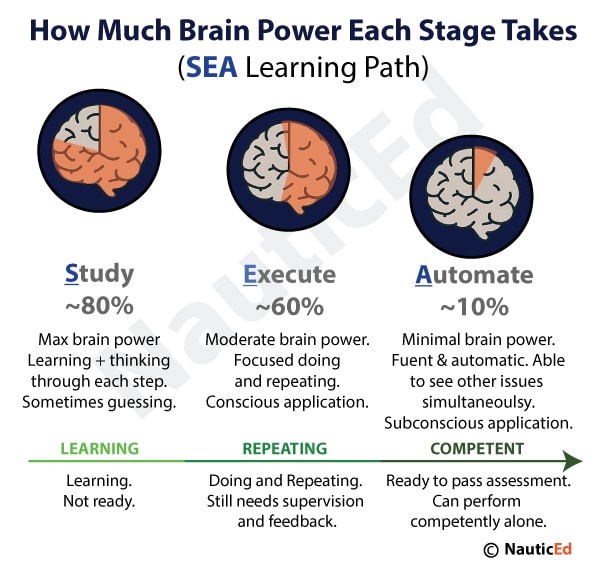
Our instructors are trained that you’re most ready to pass an assessment when you’re close to the Automate stage for the key skills.
Let’s Break SEA Down
-
Study – “I understand it (mostly) in my head”
You’re in Study when:
- You’ve watched the videos, read the course, and listened to your instructor.
- You can talk through the steps, but doing them still feels new.
- You sometimes freeze or mix up the order.
Example:
You can explain how to perform an MOB maneuver or hoist the main, but if your instructor suddenly says “Okay, you do it,” you feel a bit lost.
This is a good, necessary phase, but it’s too early to expect a pass on an assessment.
-
Execute – “I can do it, but I still have to think hard”
You’re in Execute when:
- You can perform the maneuver (tacking, gybing, docking, anchoring, reefing) while your instructor is nearby.
- You still like having them there to coach and confirm your decisions.
- Your brain feels busy: “Okay, do this, then that, don’t forget this…”
Example:
You can dock the boat when your instructor is standing by your shoulder, reminding you when to start the turn or adjust speed.
This is where many students ask for an assessment—but in most cases, you’re not quite there yet. You’re using a lot of brain power just to manage the mechanics, which leaves less capacity for big-picture safety and judgment.
-
Automate – “I can do this smoothly while managing everything else”
You’re in Automate when:
- You can perform a skill repeatedly and smoothly without step-by-step coaching.
- You still pay attention, but the mechanics feel natural and calm.
- You have brain space left over to:
- Watch traffic
- Communicate with crew
- Check depth and hazards
- Think ahead to the next step
Example:
You can dock in a different berth, with wind from a different direction, and still manage speed, angle, and lines confidently—while talking your crew through what you’re doing.
This is where assessment and sign-off belong.
How to Tell Where You Are on the SEA Path
Pick a skill (e.g., docking, anchoring, reefing) and ask yourself:
Study question
- I can explain the steps and the “why” behind them to someone else. But do I still need to think hard just to remember the sequence?
If “yes,” you’re probably still in Study.
Execute questions
- Can I usually perform the skill successfully with my instructor nearby?
- Do I rely on them to prompt or confirm key steps?
- Do I feel drained or overloaded after doing it?
If “yes,” you’re in Execute.
Automate questions
- Could I do this skill three times in a row, in slightly different situations, with similar results?
- If my instructor went quiet for a few minutes, would I still feel in control?
- Am I able to notice other things (traffic, depth, crew) while performing the skill?
If “yes,” you’re moving into Automate—the right zone for assessment.
Getting Yourself From Execute to Automate
Here are ways you can actively push yourself toward Automate:
- Ask for repetition in varied conditions
- “Can we practice docking on a different finger?”
- “Can I do the anchoring this time, then you debrief me?”
- Talk through your plan out loud
- This helps organize your brain and shows your instructor how you’re thinking.
- “My plan is: approach at 1–1.5 knots, start the turn here, neutral, then short bursts astern…”
- Use quiet time to mentally rehearse
- On the mooring or at anchor, run through the steps in your head:
- “If I had to depart this berth right now, what would I do? What’s step one?”
- On the mooring or at anchor, run through the steps in your head:
- Connect theory to practice
- Revisit the online course after a day of sailing.
- Things that felt abstract will suddenly make a lot more sense.
- Ask your instructor where they think you are
- “For docking and MOB, am I in Study, Execute, or Automate right now?”
- “What would you want to see from me before you’d feel comfortable signing off?”
- When Should You Ask for an Assessment?
You don’t need to be at Automate for every single possible edge case—no one is.
But for core skills (docking, close-quarters maneuvering, sail handling, MOB, anchoring, basic navigation), you should be much closer to A than S.
A good rule of thumb:
If you feel like you’re mostly in Execute—you can do it, but it’s still stressful—
you probably need more practice before a formal assessment.
If you feel:
- Calm,
- Consistent,
- Able to self-correct,
- And your instructor has stepped back a bit,
…then you’re likely approaching Automate, and it’s reasonable to talk about assessment.
Final Thought
The goal of an assessment isn’t just to hand you a piece of paper. It’s to confirm you’re genuinely ready to take responsibility for a vessel and crew.
Understanding Study → Execute → Automate helps you:
- Be kinder to yourself in the early stages,
- Ask for the right kind of practice,
- Celebrate little failures and weaknesses. It means you just identified them and know that you are not yet in Automate
- And request an assessment at the point where you’re truly ready to sail with confidence, not just with a certificate.
Bring this up with your instructor. Ask:
“For each key skill, what would Automate look like to you?”
That conversation alone will move you much closer to being ready to pass.
NauticEd EDU-4 Instructors
At NauticEd, we take competence seriously as we do the word “Certify”. We don’t just check boxes to say we taught you this – we evaluate you and give honest feedback on how you’re doing. We love teaching but we love developing you into a competent boater even more. Find a NauticEd sailing or powerboating instructor here.