
How Does Wind Gradient Affect Apparent Angle
We had to have fun with this article because it debunks some serious yacht club talk. The story starts with a pretty cool animation video that we did showing how moving the headsail fairlead car forward and after which is how the tension on the leech is changed to close off the twist out at the top of the sail.
So watch this video below. You’ll see how moving the fairlead forward pulls more down on the leech and closes the twist. This thus changes the direction of the exiting air and thus puts more force on the upper part of the sail. When you do this you get more healing of the boat.
Conversely, moving the fairlead aft puts less tension on the leech of the sail and thus allows the sail to twist out at the top and thus spill out the air – giving less directional change to the air. This decreases the force at the top of the sail and reduces the heeling of the boat.
You can thus use the fairlead in this manner to trim the headsail.
Ok, now watch the video to see this effect. Then let’s get to the fun story.
We posted this video on Facebook and got a completely obnoxious comment from a fellow called Michael about how it was all rubbish and we should stop posting such rubbish. And thus creates the story. But to be fair, he has a point which we do acknowledge.
The Engineer and the Crusty Old Sailor
There was once an argument at the yacht club between an engineer and a crusty old sailor.
The crusty old sailor had been haunting the same bar stool for 40 years, surrounded by a circle of equally weathered dockbound “philosophers”. They all knew the rules of sailing life, and more importantly, they knew them with absolute confidence.
“One thing’s for sure,” one of them grumbled over the top his drink, “there be no ropes on a boat.”
“Aye!” the others replied in chorus. “No ropes on a boat!”
Just then, a passerby from the dock called out, “What about the bell rope?”
The old sailors paused.
“Uuuhh… arrrhh… well, there is that one,” one finally admitted. “but nay there be any others”.
“The bucket rope” murmured the bartender.
The philosophers pretending not to hear all nodded sideways solemnly, as if this minor crack in the foundation of nautical certainty changed nothing at all. Then, just as quickly, they returned to their usual rhythm of sea stories, sayings, and inherited wisdom.
After a while, one of the old salts leaned back and declared, “Arrrhh, there be a huge difference between the angle o’ the wind at the top o’ the mast and the bottom o’ the mast due to wind gradient.”
“Ooooh arrrr, ye be right there,” the others muttered approvingly, because they had all heard this same thing from self-proclaimed instructors, old captains, race crews, grandfathers, and other yacht-club sages before them.
Then an engineer walking by stopped and asked a dangerous question:
“Has anyone ever actually calculated it?”
The table went quiet.
“Ooooh arrrr,” one of the crusty sailors replied at last, “nay, no need, young snapper. We know it.”
And that, right there, is where this story begins and ends.
Because sailing is full of handed-down truths. Many of them are sort of correct. Some are half-right. And some are right in principle but wildly exaggerated in practice. The idea that the wind angle at the top of the mast is dramatically different from the wind angle at the bottom is one of those beliefs that gets repeated so often it starts sounding like law.
But what happens when you actually do the math?
That is exactly what we set out to examine.
The Claim
The claim is familiar:
“The wind at the top of the mast is at a much different angle than it is at the bottom, so the top of the headsail must be trimmed very differently.”
Now, there is a grain of truth in that.
With wind gradient, the wind speed increases with height above the water because surface friction slows the air closer to the water. If the direction of the true wind stays the same, but the speed increases aloft, then due to the movement of the boat the apparent wind angle aloft shifts slightly aft.
So yes, the top of the sail does “see” a somewhat different apparent wind angle.
But here is the key question the engineer infered:
How much different?
That is where sailor folklore and actual math calculations can part company.
But first, let’s look at the difference in velocity on an average 15 knot day between 5 ft off the surface and the top of the mast at say 40 feet.
Back to the Story

The engineer spun on his stick legs and drew a shiny mechanical pencil from his pocket protector.“There’s a well-known empirical formula for how wind speed increases with height over the water. In a 1994 study based on overwater measurements in the Gulf of Mexico and off Chesapeake Bay, the mean power-law exponent for the wind profile over the ocean under near-neutral conditions was found to be ‘0.11 ± 0.03’.”
He scratched the formula onto the napkin:
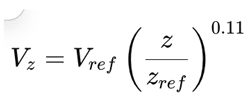 Then he said, “So if the wind is 15 knots at 5 feet off the water, what would it be at 40 feet?”
He plugged it in:
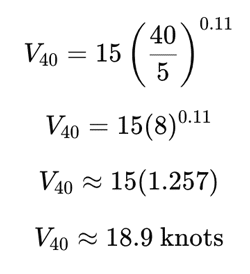 So there it was, in plain pencil lead on a yacht-club napkin:
15 knots at 5 feet becomes about 18.9 knots at 40 feet.
The engineer then booted up chatGPT on his phone app, spoke a few quiet words and showed the image generated a few seconds later.
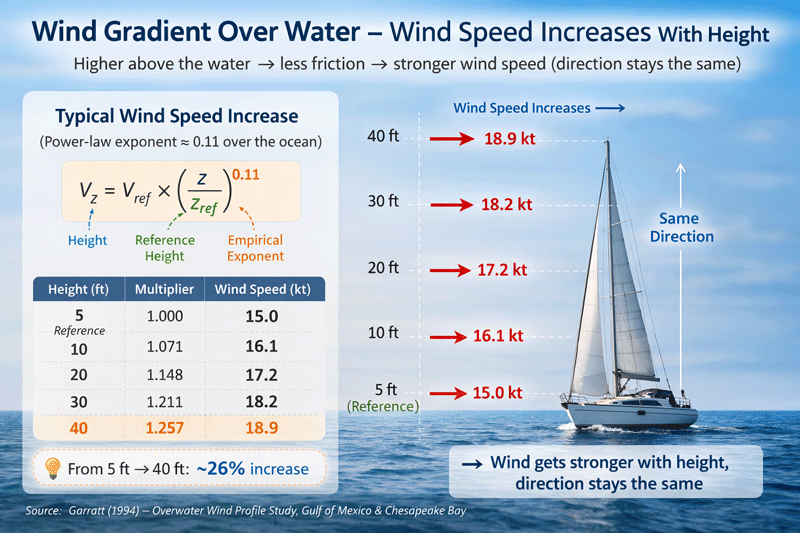
One of the crusty old sailors squinted at the numbers. “Arrrhh, I be right,” he pronounced, “so the wind does increase up the mast.”
“Aye,” said the engineer, “but not into some wild storm from another universe.”
Another old salt confidently leaned in. “And what does that do to the angle? It must be huge me young snapper.”
The engineer smiled, “That,” he said, “is pure vector mathematics. Yes, the apparent wind angle aloft changes. Let’s take a typical sailing angle of 30 degrees of apparent wind angle at the boom height above the water. The boat will make about 7 knts. Adding the vectors allows me to calculate the true wind angle. That angle will stay constant direction as the vector length increases.”
“Aye but my boat’ll go faster than ol’ Jockos ere” one ‘philosopher’ croaked.
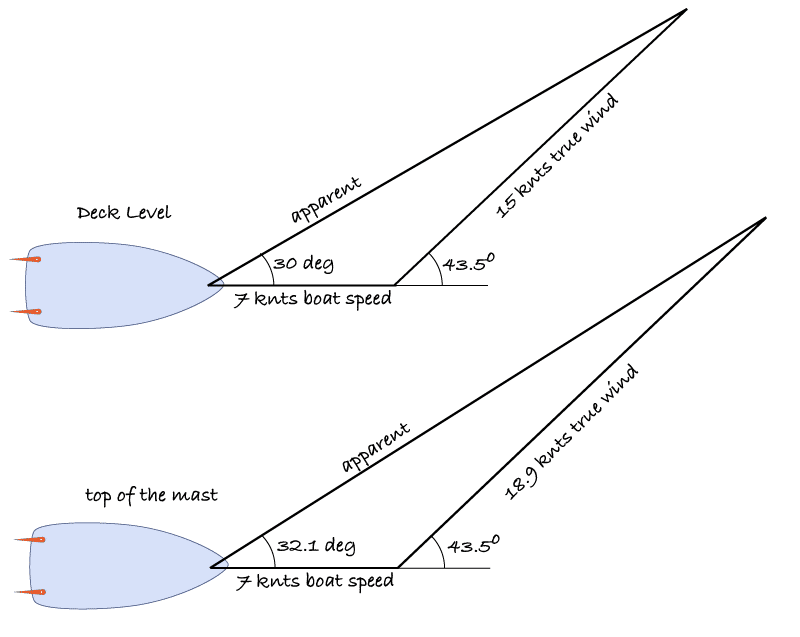
The engineer continued, “But when you actually do the vector math, in the example the apparent wind only shifts by about 2.1 degrees. Not 10 degrees. Not some giant mystical masthead miracle. Just over two degrees. Look, I keep the boat speed and the true wind angle the same and increase its vector to 18.9. The apparent wind angle only changes by just over 2 degrees.”
The room went quiet enough to hear the ice drop to the floor by the bartender – afraid of what was to happen next. The Commodore snickered and slinked away. The secretary pretended to riffle through invoices.
“What?” said the engineer, unbeknownst to his disent. “Its just math” he said feeling like he needed to defend himself. “If you want me to I can show how it gets even less if the boat goes slower than 7 knots?”
“Ohh arrrh, no she be right now off you go – shoo along now” said the elder of the philosophers.
“Ayeeee, but he didn’t take into account Coriolis and wind shear – that be a different story” said Jocko. “My granpape told me it be huge. Huge I’m tellin ya”
In Summary
So yes, the apparent wind angle does change with height due to wind gradient, and the upper part of the sail may want to be eased slightly to match that more aft apparent wind angle. But when you actually do the math, that angle change is surprisingly small — often only a couple of degrees in a typical upwind case, not the dramatic 10-degree shift of yacht-club folklore. The bigger effect by far is the increase in wind speed and therefore wind loading higher up the sail. And because that force is acting farther above the water, it creates a much greater heeling moment. That is why opening the leech and allowing twist aloft is so important in stronger breeze: not just to accommodate a small apparent-wind angle change, but more importantly to bleed off power high in the rig and keep the boat flatter, more balanced, and faster.
Bonus Section
Wind Gradient Over Water
Example table using a typical over-water wind profile. Surface reference wind speeds are shown at
5 ft above the water, with the assumed boat speed for each case added next to the surface wind speed.
Note that these are for
| Height off Water | 5 kt wind Boat speed: 2.5 kt |
10 kt wind Boat speed: 5 kt |
15 kt wind Boat speed: 7 kt |
20 kt wind Boat speed: 8 kt |
25 kt wind Boat speed: 9 kt |
|---|---|---|---|---|---|
| 5 ft | 5.0 kt | 10.0 kt | 15.0 kt | 20.0 kt | 25.0 kt |
| 15 ft | 5.6 kt | 11.3 kt | 16.9 kt | 22.6 kt | 28.2 kt |
| 25 ft | 6.0 kt | 11.9 kt | 17.9 kt | 23.9 kt | 29.8 kt |
| 40 ft | 6.3 kt | 12.6 kt | 18.9 kt | 25.1 kt | 31.4 kt |
Vz = V5 × (z / 5)0.11
This table assumes a typical near-neutral over-water wind gradient in normal atmospheric conditions, i.e. a cold front ripping through with a temperature gradient may change the numbers slightly.
Boat-speed assumptions used here are from a typical polar plot of a typical boat:
Wind Gradient Over Water and Apparent Wind Angle Change – starting at 30 deg
Example table using a typical over-water wind profile. Surface reference wind speeds are shown at
5 ft above the water, with the assumed boat speed for each case added next to the surface wind speed.
For each case, the surface-level apparent wind angle is fixed at 30°, and the apparent wind angle aloft is calculated from the increased true wind speed with the same true wind direction.
| Height off Water | 5 kt wind Boat speed: 2.5 kt |
10 kt wind Boat speed: 5 kt |
15 kt wind Boat speed: 7 kt |
20 kt wind Boat speed: 8 kt |
25 kt wind Boat speed: 9 kt |
|||||
|---|---|---|---|---|---|---|---|---|---|---|
| Wind Speed | Apparent Angle | Wind Speed | Apparent Angle | Wind Speed | Apparent Angle | Wind Speed | Apparent Angle | Wind Speed | Apparent Angle | |
| 5 ft | 5.0 kt | 30.0° | 10.0 kt | 30.0° | 15.0 kt | 30.0° | 20.0 kt | 30.0° | 25.0 kt | 30.0° |
| 15 ft | 5.6 kt | 31.2° | 11.3 kt | 31.2° | 16.9 kt | 31.1° | 22.6 kt | 31.0° | 28.2 kt | 30.9° |
| 25 ft | 6.0 kt | 31.7° | 11.9 kt | 31.7° | 17.9 kt | 31.7° | 23.9 kt | 31.5° | 29.8 kt | 31.3° |
| 40 ft | 6.3 kt | 32.2° | 12.6 kt | 32.2° | 18.9 kt | 32.1° | 25.1 kt | 31.9° | 31.4 kt | 31.7° |
Vz = V5 × (z / 5)0.11
This table assumes a typical near-neutral over-water wind gradient.
In each case, the apparent wind angle at 5 ft is set to 30° and the true wind direction is held constant with height.
Variance due to apparent wind angle
The above tables and the story were calculated using a 30-degree apparent wind angle on the face of the helmsperson – a close haul.
Now let’s look at how the apparent wind angle changes going up the mast with an initial 90-degree wind angle on the face of the helmsperson – a beam reach.
Wind Gradient Over Water and Apparent Wind Angle Change = starting at 90 deg
Example table using a typical over-water wind profile. Surface reference wind speeds are shown at
5 ft above the water, with the assumed boat speed for each case added next to the surface wind speed.
For each case, the surface-level apparent wind angle is fixed at 90°, and the apparent wind angle aloft is calculated from the increased true wind speed with the same true wind direction.
| Height off Water | 5 kt wind Boat speed: 2.5 kt |
10 kt wind Boat speed: 5 kt |
15 kt wind Boat speed: 7 kt |
20 kt wind Boat speed: 8 kt |
25 kt wind Boat speed: 9 kt |
|||||
|---|---|---|---|---|---|---|---|---|---|---|
| Wind Speed | Apparent Angle | Wind Speed | Apparent Angle | Wind Speed | Apparent Angle | Wind Speed | Apparent Angle | Wind Speed | Apparent Angle | |
| 5 ft | 5.0 kt | 90.0° | 10.0 kt | 90.0° | 15.0 kt | 90.0° | 20.0 kt | 90.0° | 25.0 kt | 90.0° |
| 15 ft | 5.6 kt | 93.5° | 11.3 kt | 93.8° | 16.9 kt | 93.4° | 22.6 kt | 92.9° | 28.2 kt | 92.5° |
| 25 ft | 6.0 kt | 95.5° | 11.9 kt | 95.3° | 17.9 kt | 94.9° | 23.9 kt | 94.1° | 29.8 kt | 93.6° |
| 40 ft | 6.3 kt | 96.8° | 12.6 kt | 96.8° | 18.9 kt | 96.2° | 25.1 kt | 95.1° | 31.4 kt | 94.5° |
Vz = V5 × (z / 5)0.11
This table assumes a typical near-neutral over-water wind gradient.
In each case, the apparent wind angle at 5 ft is set to 90° and the true wind direction is held constant with height.
Wind Shear
These examples isolate “Wind Gradient” only and do not include “Wind Shear”. “Wind Shear” is the change in wind speed and/or direction with height, and in a typical upwind case like this, the directional component is often only on the order of a few degrees — roughly 1–3° is a reasonable expectation, though it depends heavily on atmospheric stability, friction, temperature structure, and local weather. It is also influenced by latitude because the Coriolis effect is weakest at the equator and stronger toward the poles. But wind shear does not really change the core point of the video: if directional shear exists, it would tend to add to the apparent-wind difference on one tack and reduce it on the opposite tack, whereas the headsail trim lesson using the fairlead remains valid regardless. The headsail trim takeaway is still that the upper part of the sail sees more wind loading, and opening the leech or increasing twist aloft is an important tool for reducing heel and keeping the boat balanced.
LEARN SAIL TRIM
Learn more about sail trim with either NauticEd’s FREE Basic Sail Trim Course for any aspiring sailor, or learn more comprehensive techniques with the Advanced Sail Trim online course.