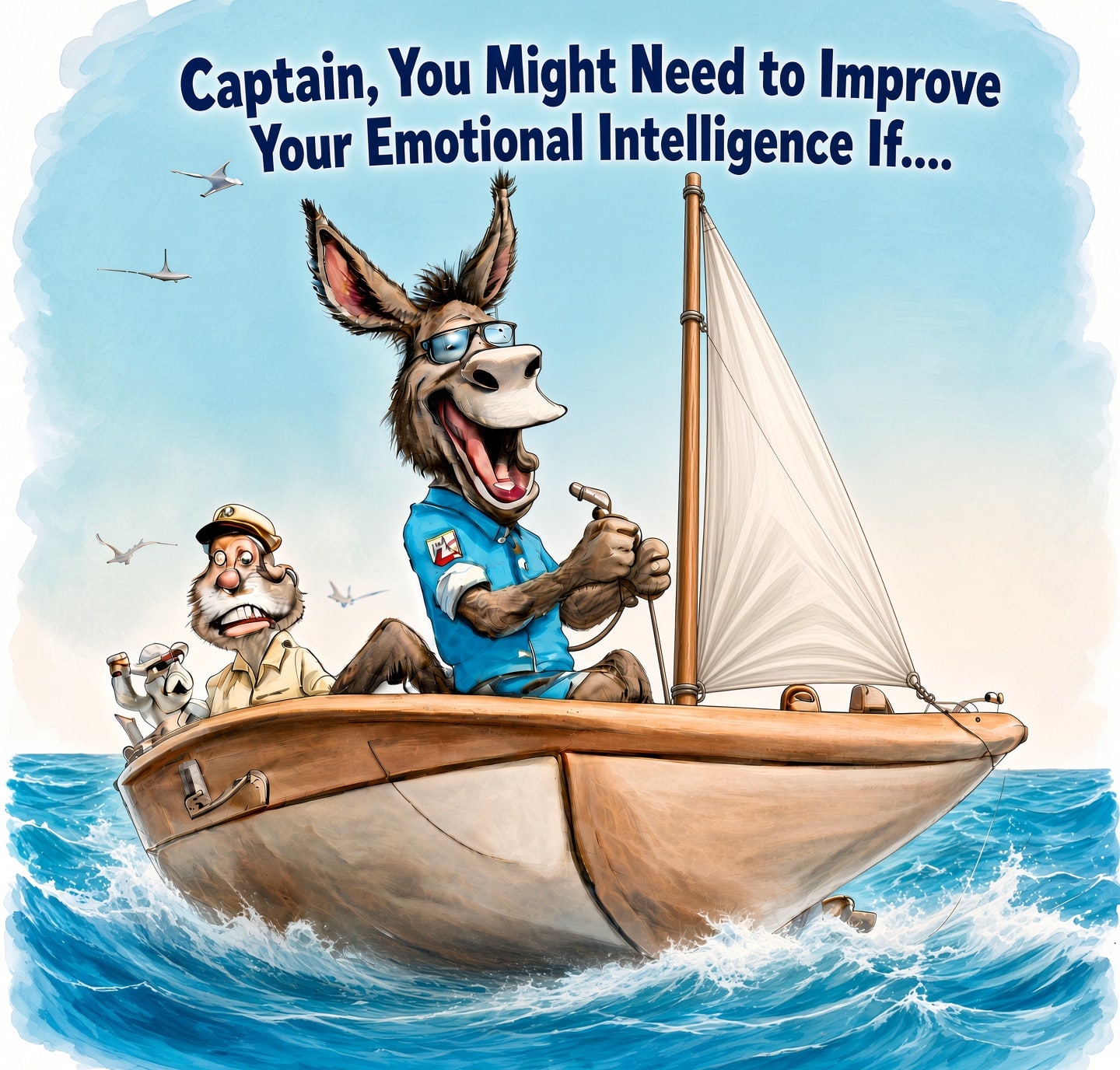
Captain, You Might Need to Improve Your Emotional Intelligence If…
by Bill Ibsen
Prelude by Grant Headifen – Global Director of Education
Being a great skipper is about far more than knowing how to sail the boat.
When you have friends and family aboard, they are trusting you—not just to keep them safe and get the boat where it needs to go, but to lead them well while you do it. And that becomes especially important when things get stressful.
A difficult docking, a fouled line, a navigation mistake, a sudden change in weather—those are the moments when your leadership really shows. One badly chosen comment, one unnecessary insult, or thirty seconds of shouting can undo a tremendous amount of respect.
You are the skipper, but you haven’t been issued a license to bark commands at people. This isn’t the military. In fact, there are much more effective ways to get people to listen, respond quickly, learn, and work together—even when something needs to happen right now.
The best skippers create calm rather than chaos. They make their crew feel capable instead of incompetent. They recognize when someone is confused, frightened, frustrated, seasick, or simply inexperienced—and they adjust how they lead.
And here is something worth remembering: people may forget the perfect tack you made or how beautifully you backed into the dock, but they will remember how you made them feel while they were on your boat.
That’s why emotional intelligence isn’t some soft, fluffy addition to seamanship. It is a genuine command skill. It makes you a better leader, a better teacher, a safer skipper, and frankly, someone people actually want to go sailing with again.
Bill Ibsen is the author of one of my favorite NauticEd courses, Effective Command through Emotional Intelligence (EQ). Bill takes the principles of emotional intelligence and applies them specifically to leadership aboard a boat—where confined spaces, different personalities, varying experience levels, fatigue, weather, and stress can make otherwise reasonable human beings behave in some very interesting ways.
The reviews from students who have taken the course speak for themselves.
But before you dive into the course, have a little fun with the list below.
Some of these may make you laugh. A few might make you wince. And if one or two feel slightly too familiar… well, perhaps Bill wrote this course for you.
Then imagine the alternative.
Imagine being the skipper who has the technical skills and the leadership skills. The skipper whose crew feels safe asking questions. The skipper who can correct a mistake without humiliating someone. The skipper who stays composed when the maneuver goes sideways. The skipper who teaches people, builds confidence, shares the helm, thanks the crew, and finishes the day with everyone already talking about when they can go sailing together again.
That’s the skipper worth becoming.
And that’s when you know you’ve really mastered command: people aren’t trying to find an excuse to get off your boat—they’re leaping over each other to get back on it.
So, here’s the list below. Some won’t apply, but some may ring a bell.
- Your own family has quietly stopped sailing with you.
- People keep telling you you’re oblivious to how they feel. You remain unconvinced.
- You rage at referees like a man possessed, then describe yourself as “calm and unemotional.”
- Conflict comes up and you reach for the three classic reactions: a joke, silence, or the nearest exit.
- You’ve thought, “Sure I explode at slow crew. They should’ve seen it coming.”
- Good crew keep disappearing. In your view, the world is just running out of competent people.
- Your entire emotional vocabulary consists of “good,” “mad,” “sad,” “glad,” and “hungry.”
- New sailors don’t come back. The reasons are “stupid.” You don’t ask what they are.
- You’ve thought, “Why give an order without an insult? They laugh, don’t they?”
- You cannot remember the last apology you made. To anyone.
- Your version of an apology has never included the words “I was wrong.”
- When the crew blows a maneuver, volume equals victory. The scream feels good. They needed to hear it.
- Sarcasm isn’t a slip. It’s strategy. After the cabin goes quiet, you add, “I was only kidding.”
- A crew member gets emotional and you instantly turn into Mr. Fix-It. Listening can wait.
- Other people’s feelings make you itchy. You shut them down before they spread.
- Emotions are for soft people. You would still trade a limb for the excitement to helm the 1947 Endeavour under full sail.
- Your wake is littered with wrecked relationships. You call it standards.
- Performance first. People second. Can’t do the job? There’s the dock.
- Crew feedback is weakness. Captains don’t take surveys. You have never asked, “What was it like being on my boat today?”
- Blame is instinct. Responsibility is optional. You lose the regatta and the first name you say isn’t yours.
- You swear you love sailing for the numbers – vectors, hydrodynamics, data. The emotions are incidental.
- You call it “direct.” Everyone else calls it belittling.
- You hog the helm all day, then wonder why no one else feels like part of the crew.
- You notice a fouled sheet before you notice a frightened face.
- Your safety briefing is a monologue. Questions are interruptions. You repeat yourself louder instead of checking whether they understood.
- You say “my boat, my rules” more often than “how are you doing?”
- You thank the wind, the boat, and the forecast. Rarely the people.
- Someone looks seasick or scared and you turn your attention to sail trim.
- You keep a private scorecard of who last screwed up. They can feel it.
- New crew ask a basic question and you sigh like they asked you to untangle a line fouled in the prop.
- You compare today’s crew, unfavorably, to a legendary crew from 1998.
- You save the best version of yourself for the people you like. The rest get command voice.
- You think morale is what happens when the beer comes out, not what you built all day.
- You can recite every COLREGS rule and still miss the human one: people remember how you made them feel.
- Someone suggested you taking NauticEd’s Effective Command through Emotional Intelligence (EQ). You didn’t need the description. The title was enough to dismiss.
Take the Effective Command through Emotional Intelligence Course