
How a Thunderstorm Forms and Propagates
And Why They Are So Dangerous to Boaters
If enough atmospheric instability, moisture, and lift are present, then strong updrafts can develop in the cumulus cloud, leading to a mature, deep cumulonimbus cloud, i.e., a thunderstorm producing heavy rain. In addition, cloud electrification occurs within cumulonimbus clouds due to many collisions between charged water droplets, graupel* (ice-water mix), and ice crystal particles, resulting in lightning and thunder.
*Graupel is a soft ice pellet that forms when supercooled water droplets freeze onto snow or ice particles inside a cloud. In thunderstorms, collisions between graupel, ice crystals, and water droplets help separate electrical charges, leading to lightning.
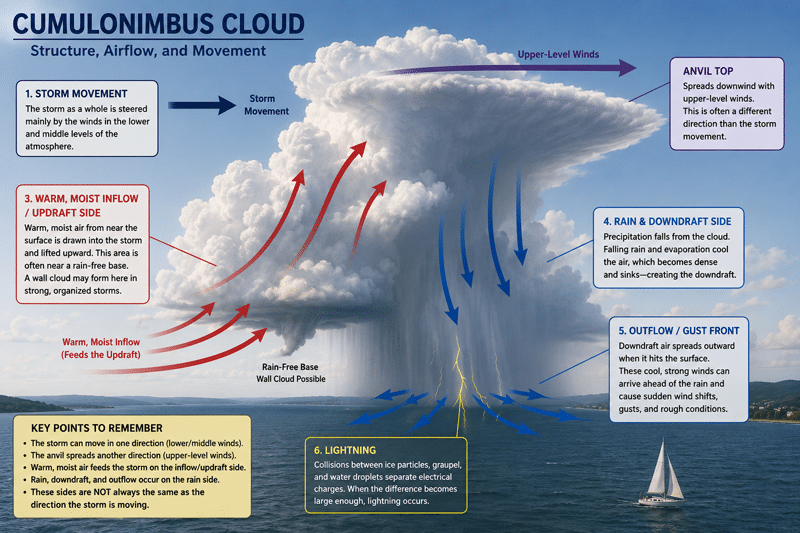
How a Cumulonimbus Thunderstorm Builds, Rains, and Moves
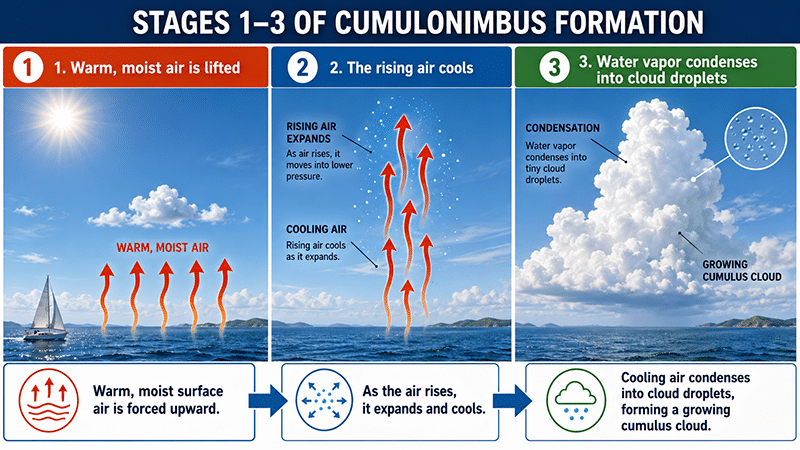
- Warm, moist air is lifted.
A thunderstorm begins when warm, moist air near the surface is forced upward. This lift may come from surface heating, a cold front, a sea breeze boundary, mountains, or converging winds. - The rising air cools.
As the air rises, it expands because air pressure is lower higher in the atmosphere. As it expands, it cools. - Water vapor condenses into cloud droplets.
Cooler air cannot hold as much water vapor. When the rising air cools enough, water vapor condenses into tiny cloud droplets and ice particles. This forms the growing cumulus cloud.
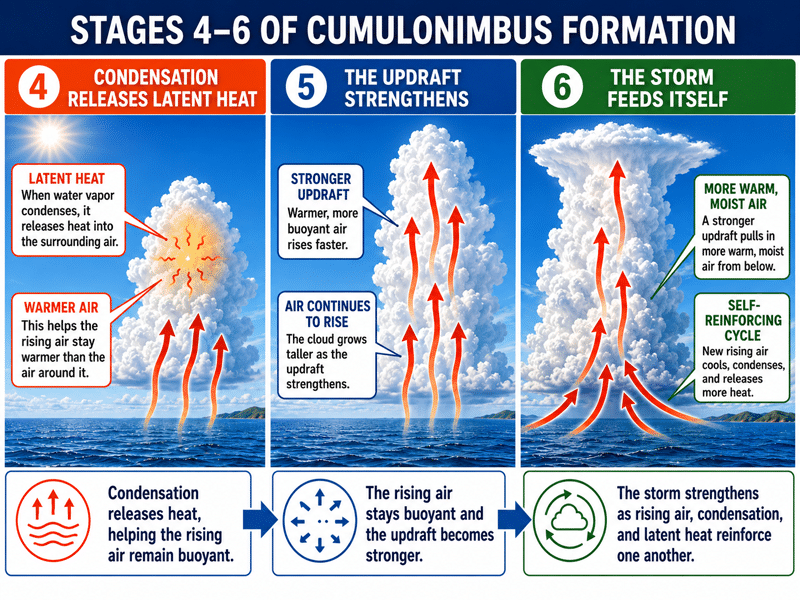
- Condensation releases latent heat.
When water vapor condenses, it releases heat into the surrounding air. This released heat helps keep the rising air warmer than the air around it. - The updraft strengthens.
Because the air inside the cloud remains warmer and more buoyant, it continues to rise. This stronger updraft pulls in even more warm, moist air from below. - The storm feeds itself.
The new warm, moist air rises, cools, condenses, and releases more latent heat. This cycle strengthens the updraft and allows the cloud to grow taller and more powerful.
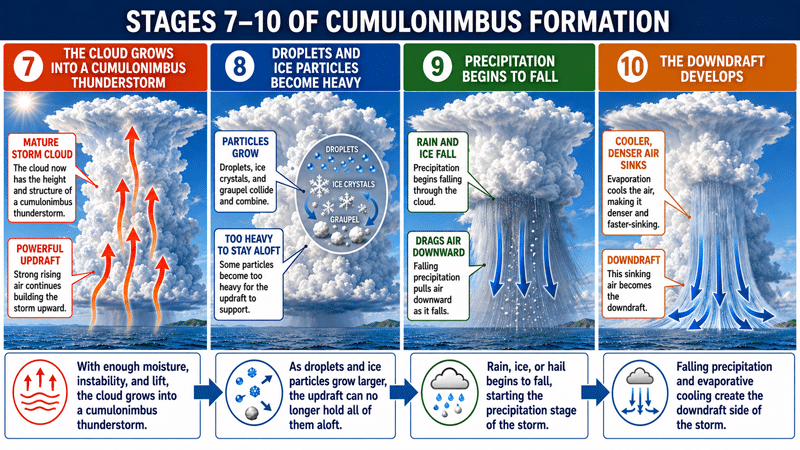
- The cloud grows into a cumulonimbus thunderstorm.
If there is enough moisture, instability, and lift, the cloud can grow high into the atmosphere. At this stage, it becomes a cumulonimbus cloud capable of producing heavy rain, lightning, gusty winds, and sometimes hail. - Droplets and ice particles become heavy.
Inside the storm, cloud droplets, ice crystals, and graupel collide and combine. As they grow larger and heavier, the updraft can no longer hold all of them aloft. - Precipitation begins to fall.
Rain, ice, or hail begins falling through the cloud. As it falls, it drags air downward with it. - The downdraft develops.
Falling precipitation pulls air downward. At the same time, some rain evaporates into drier air, which cools the air. Cooler air is denser, so it sinks faster. This sinking air is the downdraft.
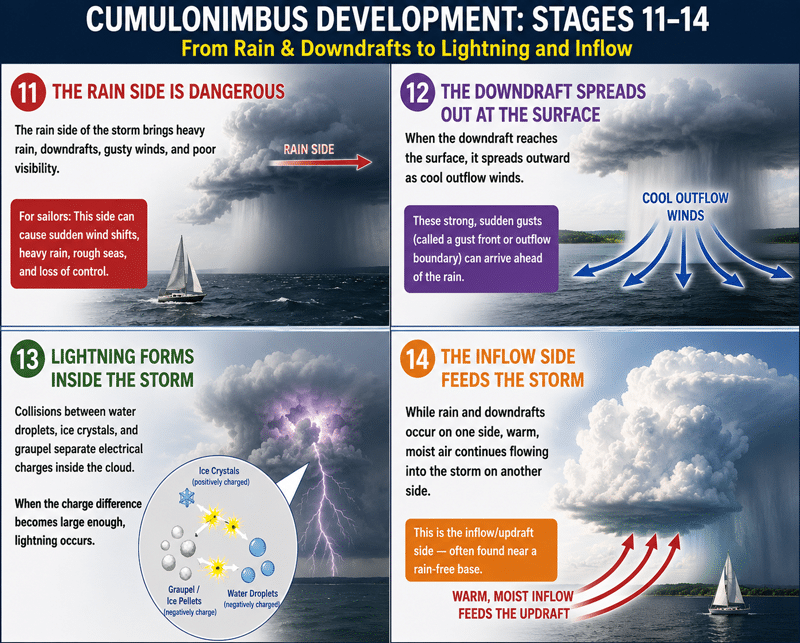
- The rain side becomes dangerous.
The rain side of the storm is where heavy precipitation, downdrafts, reduced visibility, and sometimes hail occur. For sailors, this area can bring sudden wind shifts, heavy rain, poor visibility, rough water, and loss of control. - The downdraft spreads outward at the surface.
When the downdraft reaches the surface, it spreads outward because it cannot continue downward. This creates strong, cool outflow winds. These gusts can arrive before the rain and may be much stronger than the surrounding wind. - Lightning forms inside the storm.
Strong updrafts and downdrafts move water droplets, graupel, and ice crystals around inside the cloud. These particles collide and separate electrical charges. When the charge difference becomes large enough, lightning occurs. Thunder is the sound produced by the rapid heating and expansion of air around the lightning channel. - The inflow side continues feeding the storm.
While rain and downdrafts occur on one side of the storm, warm, moist air may continue flowing into the storm on another side. This is the inflow/updraft side. It is often found near a rain-free base.
- A wall cloud may form under the updraft area.
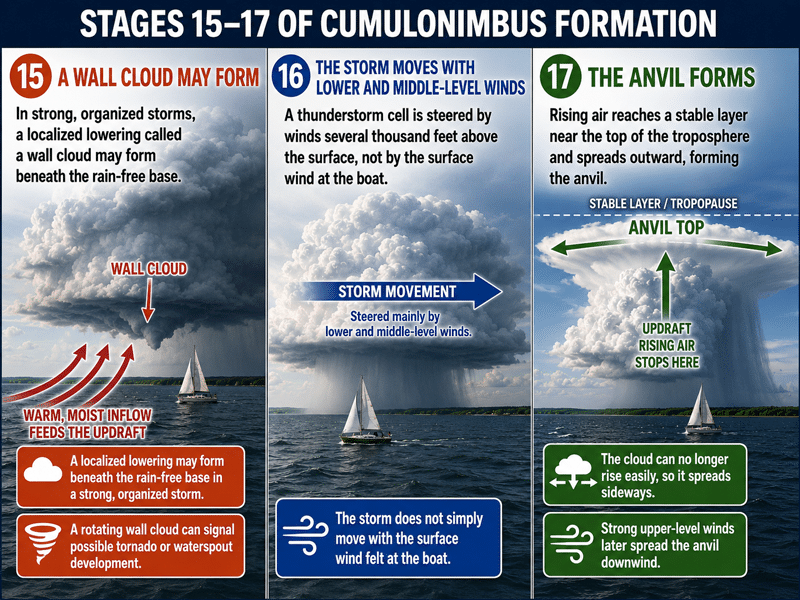
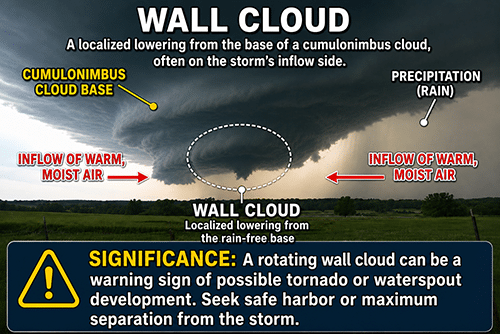
In a strong, organized thunderstorm, a localized lowering called a wall cloud may form beneath the rain-free base. A rotating wall cloud is significant because it can be associated with tornado or waterspout development. - The storm moves with lower and middle-level winds.
A cumulonimbus cloud does not simply move with the wind felt at the surface. Because the storm extends high into the atmosphere, its overall movement is usually steered by the surrounding winds through the lower and middle levels of the atmosphere. - The anvil forms when the cloud can no longer rise easily.
As the powerful updraft reaches the upper atmosphere, it eventually reaches a stable layer near the top of the troposphere called the tropopause. At this level, the rising air is no longer able to continue climbing as easily, so the cloud spreads sideways.
- Upper-level winds spread the anvil.
Once the cloud top spreads sideways, strong upper-level winds push it downwind. This creates the flat, spreading anvil shape. The anvil shows the direction of upper-level winds, not necessarily the direction the storm itself is moving. - The storm direction and anvil direction may differ.
The storm cell is generally steered by lower and middle-level winds, while the anvil is shaped by upper-level winds. These winds can blow in different directions, so the anvil may point one way while the storm moves another way. - For sailors, avoid the entire cumulonimbus cloud.
Do not try to find the “safe side” of a thunderstorm. The rain side can bring heavy rain, lightning, downdrafts, gust fronts, and poor visibility. The rain-free inflow side can still be dangerous because it feeds the storm and may contain a wall cloud. The safest choice is to avoid the entire storm with as much separation as possible, reduce sail early, monitor weather information, and seek safe shelter when available.
Wall Clouds
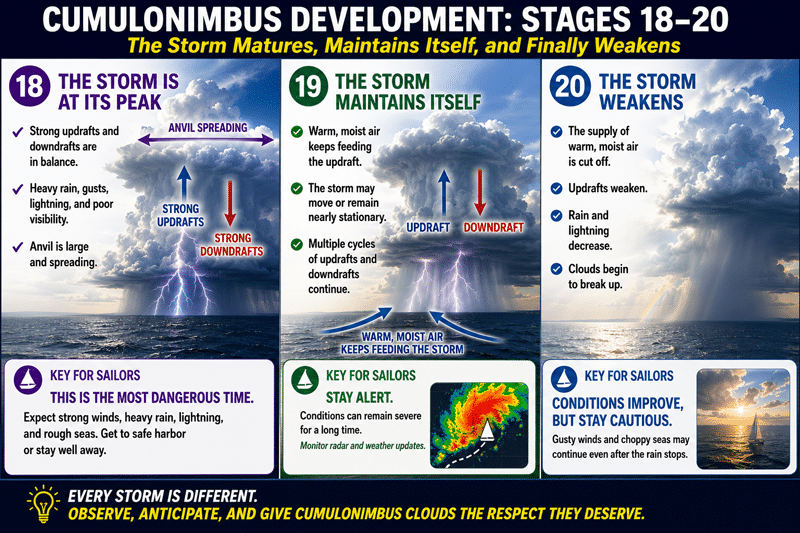
Wall clouds deserve special attention because they form in the storm’s inflow/updraft region, often beneath a rain-free base. A wall cloud appears as a localized lowering from the main cumulonimbus cloud base, where warm, moist air is being pulled into the thunderstorm and lifted rapidly upward. Not every wall cloud rotates, and not every wall cloud produces severe weather, but a rotating wall cloud is a serious warning sign because it may indicate that the storm is becoming organized enough to produce a tornado or waterspout. For sailors, the important takeaway is that the rain-free side of a storm is not automatically safe. It may be the inflow side feeding the storm, and if a wall cloud is present, the safest response is to create maximum separation from the thunderstorm, reduce sail early, monitor weather alerts, and seek safe harbor if possible.
You can learn more with the Coastal Navigation Course and Free Navigational Rules
Learn more about planning and navigating routes on boating adventures in NauticEd’s Coastal Navigation course. Or, just sign up with the FREE (no obligation) Navigation Rules course.