Med Mooring Learnings
Amidst Squawkers, Gawkers, and Midnight Crooners
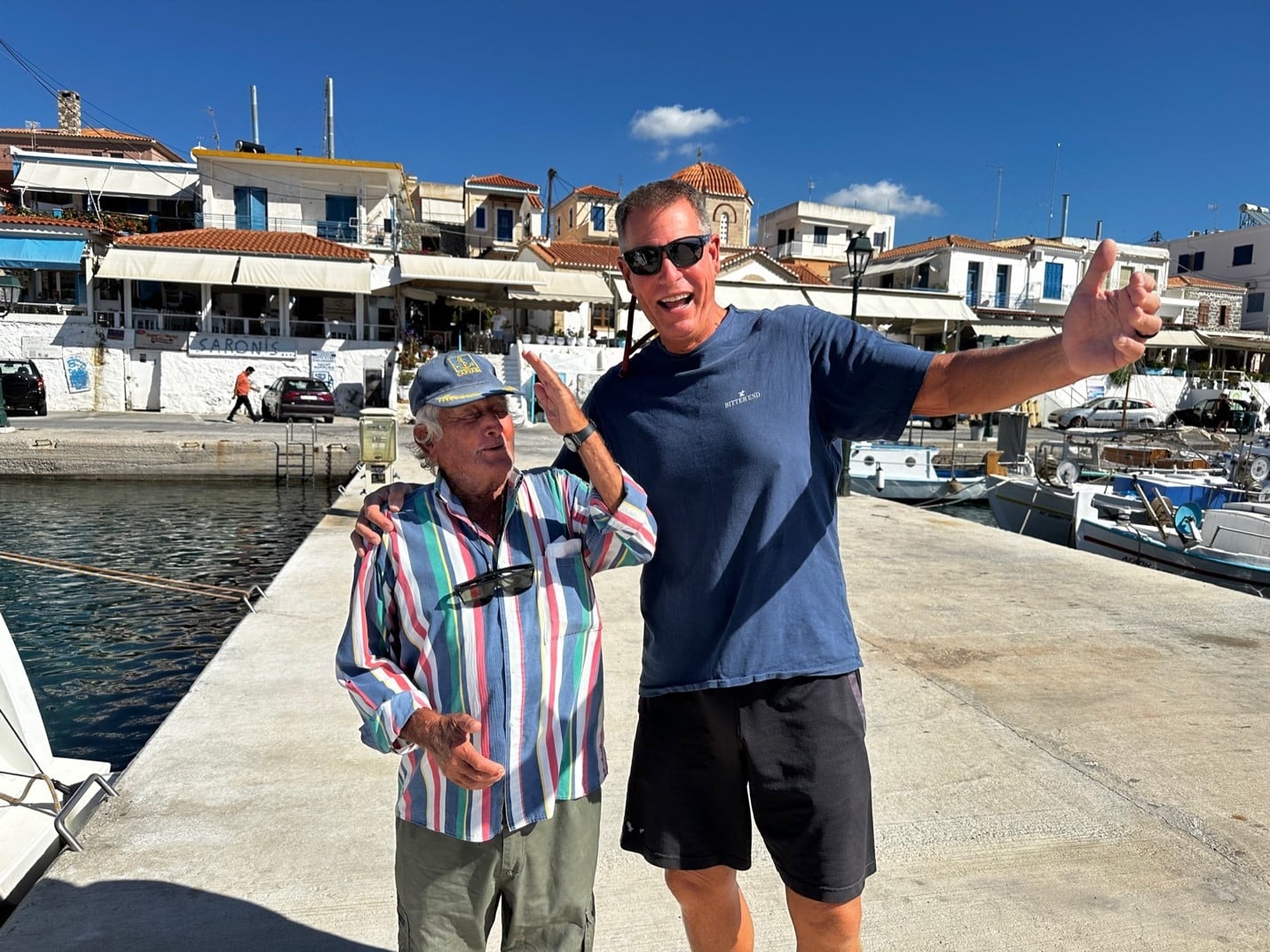
A 4-ft-tall, withered, tan, elderly Greek man patrolling as a self-appointed dockmaster immediately picked up on the delicate scent of a newbie Med Mooring skipper from across the marina. Maybe it was the 20+ knots of crosswinds that lured him off his barstool at 11 a.m. to do his part in contributing to what was likely to become a docking circus in the super-tight marina in Aegina, Greece. Maybe it was our boat’s Moorings 5000 logo that tipped him off that we were American visitors, because no Europeans would charter such a big-axx boat and attempt to dock it in this matchbox marina. Being overserved at that time of morning only deepened his resolve to passionately “help” incoming boats dock.
He spoke not a lick of English, despite his navy-blue cap embroidered with the yellow word “Captain.” I understood not a lick of Greek. And I do believe that Greek screamed makes the language even more tricky to understand – even for those familiar with it.
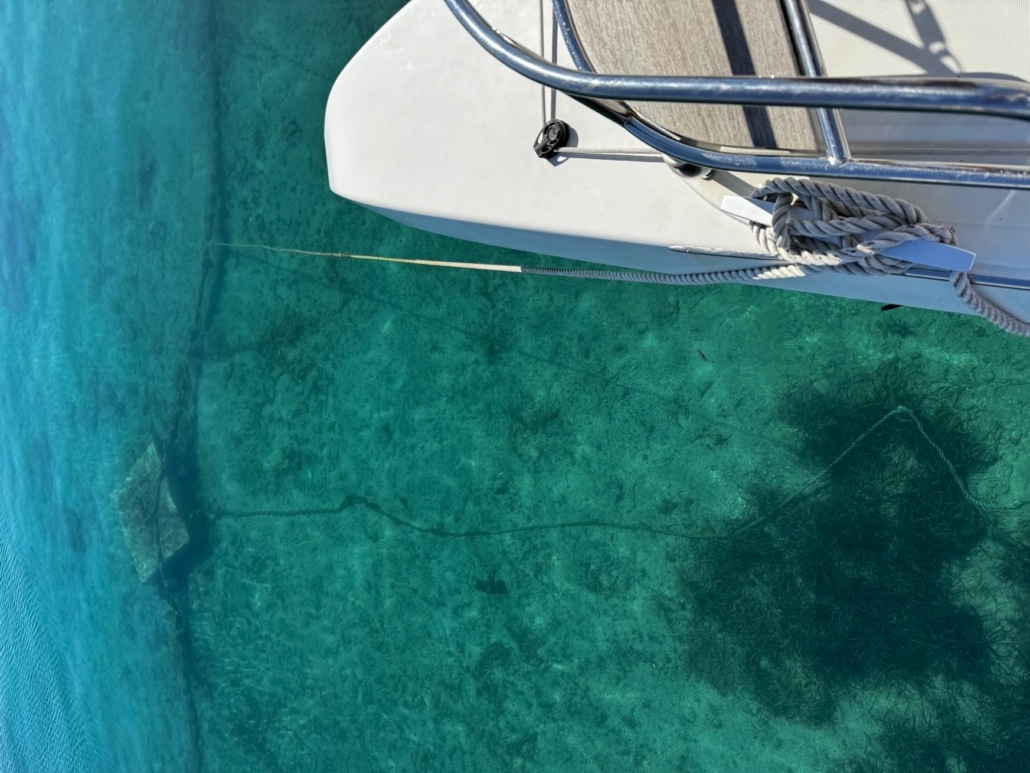
His tiny eyes locked in on me approaching the marina fairway, which was as tight as a Victorian corset. The fairway seabed was cluttered with anchor chains extending all the way across to the facing boats, virtually guaranteeing that somebody was going to cross anchors with at least three other boats when dragging up their anchor the next morning. The wind gusted harder as I slowly spun our catamaran to begin dropping anchor and backing into the slip. The tiny dock predator sensed my stress, likely from my labored breathing and protruding eyeballs.
As he crouched on the dock, waiting for my next mistake, he watched the crosswind blow my 50-ft yacht totally off-line, and I began to look forlorn. This behavior triggered his primal instincts to explode into action, completely overriding his prefrontal cortex. Why speak when you can scream?
And so he did.
In Greek.
For 20 minutes straight.
From the helm, I could see his protruding jugular vein pulsing with each firestorm of Greek instructions, accompanied by mysterious, spastic Greek gesticulations. As he observed me fumbling and getting blown farther away from my target, he became madder than a wet rooster locked out of the henhouse in a thunderstorm.
After just a few minutes of his verbal maelstrom – which attracted an even larger crowd of amused gawkers – I found I couldn’t communicate with my crew over his screaming. I suddenly began to hate him deep within my heart. I wanted him to shut his trap and go very far away. But like a leopard seeing injured prey run away, he had no choice but to make the kill.
So he persisted, undeterred with his verbal assault, which reached fever-pitched crescendos.
Yet somehow, amidst the hollering like a scalded cat, our crew ignored the noise as best they could and eventually got our behemoth docked – something resembling a Med Mooring.
OK, so my first attempt at Med Mooring as a skipper was as graceful as a calf on roller skates. But I got slightly better with some practice in Croatia, too. Here are a few lessons I learned:

Screamers Gonna Scream
Just as Taylor Swift poignantly observed, “The haters gonna hate, hate, hate,” so also are “the screamers gonna scream, scream, scream.” Just shake it off.
I don’t quite know what it is about some Europeans and Med Mooring, but it triggers something in their lizard brain that demands loud verbalization and wild gesticulation. This is especially true in 25-30+ knot crosswinds when a newbie skipper gets his yacht blown sideways against a row of moored boats.
Like NauticEd, I guess they, too, have a passion for sailing competence—plus an intolerance of the opposite. The counteractant for these social phenomena is twofold:
1. Expect it.
2. Quit mooring like a noob and learn how to perform it skillfully. Dock with authority.
Pro tip: Skillful docking doesn’t look like the skipper I watched in Croatia ram his yacht like a freight train through an outhouse into some tied-off local boats to make room for his own. Disrespect and rudeness don’t work well in any culture.
Slow Is Pro – EXCEPT When It’s Windy
There’s nuance to this catchy phrase, or its cousin, “Dock at the speed you want to crash.” When I was docking in the above example, one of my errors was going too slow for the wind conditions.
Moving 25 tons of catamaran in 5 knots of wind versus 25 knots in a crowded marina are two very different animals. More wind requires more throttle to move the boat’s sheer mass against the opposing forces of windage, especially when it’s blowing on your beam.
And don’t be like me and fly through NauticEd’s Maneuvering with Power course by memorizing some answers just to pass the test. In the real-world test above – where I needed to spring my cat upwind after having been blown downwind – I failed because I did not understand the basic physics of springing off the windward stern line combined with the effect of turning the helm to leeward and throttling the leeward engine in forward gear. If I had, I would have been able to nicely lever upwind to my target spot. No drama – and therefore no Greek obscenities needed to be shouted.
Reasonable momentum is your friend. Don’t allow the wind to overpower your vessel.
Marineros Aren’t Skippers (Or Necessarily Sober)
Depending on marineros to fill in your skill gaps in Med Mooring is a sketchy strategy. While some of these dock hands are amazingly helpful, others – when it comes to boating – are dumber than a bag of hammers.
I’ve experienced them handing my crew member the wrong slime line because they docked the previous boat using what should have been our starboard slime line. Another marinero at the bustling Hvar, Croatia quay insisted that my newbie crew member first attach the leeward slime line, repeatedly refusing to take our windward stern line, as I instructed.
Turns out he was an office guy filling in for one of the dock hands who frequently shows up drunk – but didn’t show up to work that day. And our office man was, of course, never trained in this role, but was just “helping out.”
The best strategy is to thoroughly train your crew (see next point) and ask them to listen to you – not the dock hands or a well-meaning passerby. FYI, beware that these guys may not necessarily have been trained on how to tie proper knots, so always check their work.
You Gotta Train Your Crew!
This reality “done clicked in my head” when my crew – consisting of only four ladies – arrived in Croatia. Three of the four had never been on a sailboat, so I had to train these newbies to take on multiple roles to assist me in the Med Mooring process. I was asking them to perform a complex, coordinated effort that they’d never observed.
Fortunately, they were each as sharp as a thorn on a briar bush and took instruction well. In addition to assigning each of them a role (stern line handler, bow line handler, roving fender, distance spotter) and explaining how to do it right – as well as what could go wrong – I gave them this overall instruction for slime-line Med Mooring:
Crew Preparation Checklist (Before Entering the Fairway):
• Music OFF
• Fenders deployed
• Lines flaked and ready
• Lines organized to not get on the wrong side to the stern rails
• Roles assigned and confirmed
• Boat hook at the ready
• One voice only: the skipper
Crew Role Assignment
• Stern line handlers at port and starboard quarters
• Bow/slime line handlers ready to boat hook the slime line from the quay
• Fender rover amidship leeward side
• Distance spotter aft, facing quay
Execution Order (This Order Matters)
1. Identify windward side
2. Back toward quay under control
3. Secure windward stern line first
4. Secure leeward stern line
5. Boat in forward gear to hold off the quay (extreme care to not get the slime line into the propeller)
6. Secure windward bow/slime line
7. Secure leeward bow/slime line
8. Reverse gently to tension bow lines
9. Final stern-line adjustment for the passerelle length
It’s important that newbie crew are thoroughly instructed. When they make inevitable mistakes, consider those mistakes your fault for insufficiently explaining the task(s). Make the conscious choice to always be patient and gracious with your crew.
Why Didn’t I Listen to Grant Headifen About Virtual Reality Med Mooring Practice?
OK, I did listen – but only about as well as a fencepost. I heard Grant go on and on about fighter pilots who make literally thousands of landings on the simulator before they’re ever allowed to do so in a zillion-dollar fighter jet.
So, I borrowed a friend’s Meta Quest headset and worked through some of the basic sailing virtual-reality content. I even started working through the Maneuvering Under Power VR content, which is arguably the most useful exercise in the entire package. But at the time, the software only supported monohulls, and since I almost always charter catamarans with two engines, I didn’t think the practice applied enough and lost interest.
But that was acting about as dumb as a stump. I missed a chance to build muscle memory for critical docking skills like ferrying upwind that I needed in Greece and Croatia.
Though part of me felt like a pimple-faced teen asking for a new VR headset, I recently received a new Meta Quest VR headset for Christmas. I plan to use it like a Navy fighter pilot practicing aircraft carrier landings using the new MarineVerse software update that now supports catamaran docking. No more flaccid excuses for me.
Take NauticEd’s EQ Course
Boy, am I glad I took Effective Command Through Emotional Intelligence so that I didn’t blow a gasket each time my newbie crew made a mistake under the pressure of docking in windy conditions.
Of course, like any new sailors in the learning process, they made mistakes. OK, I gotta come clean here: this is indeed a shameless plug for this $49 course, which one student recently reviewed as “one of the best and most well-thought-out classes on leadership I have ever taken.”
Shameless or not, wind, confined space, time pressure, spectators, language barriers, and libations all converge at once to make sailors blood boil – especially the skippers’. Med mooring can be a live stress test for skippers.
Skipper Command Behaviors to Practice
• Calm tone
• Short, clear commands
• No sarcasm
• No volume escalation
• Address the crew member by name so everyone know who you are giving an order to
Our crew may not remember how to tie a proper cleat hitch, but they will always remember how we, as the skipper, treated them as crewmembers. To treat them well, we’ve got to get control of our emotions and build our emotional intelligence. Our voice and demeanor set the tone for our crew.
Be Prepared for Zero Clearance Gaps with Your Neighbors
This is an American thing. We don’t touch strangers. We almost never want our boats touching other boats – particularly strange boats. We like our space and distance.
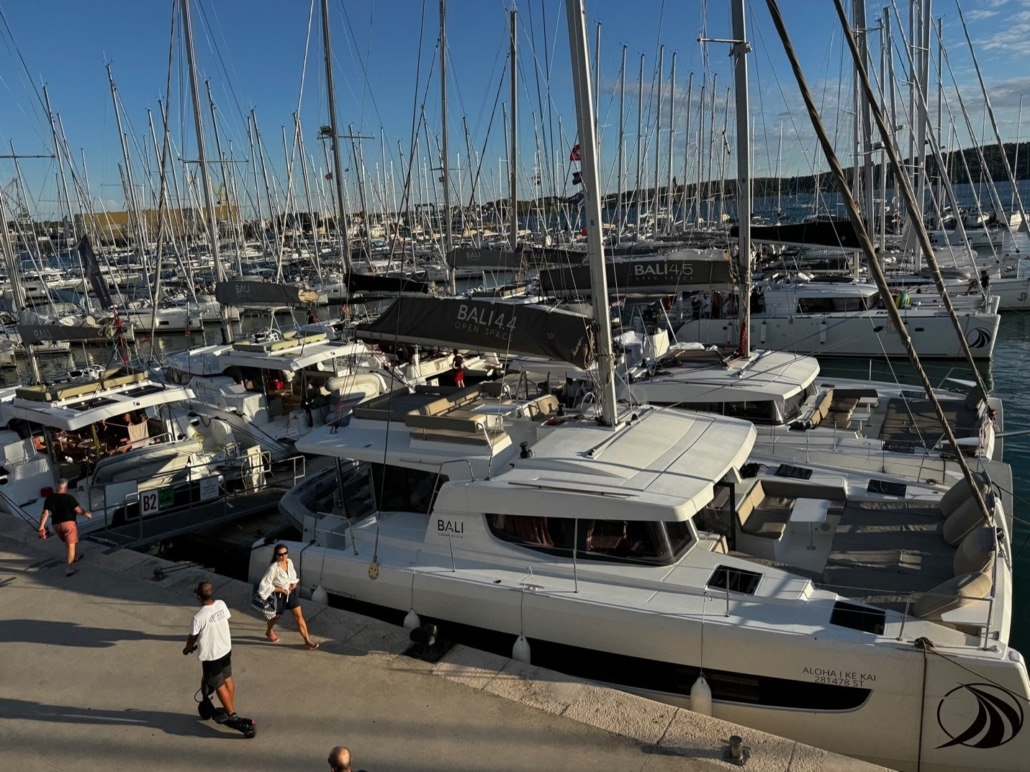
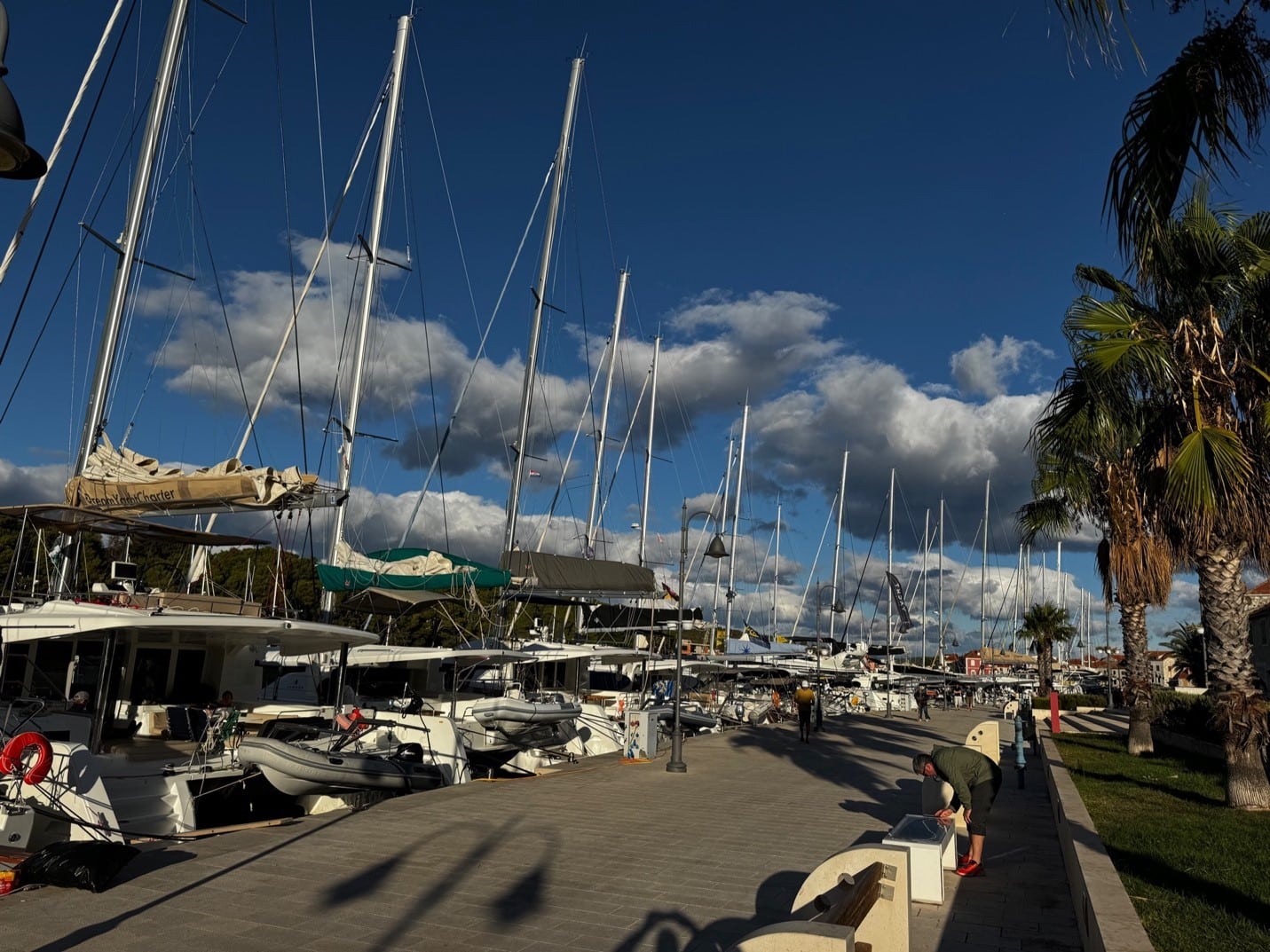
But we need to remember that the picturesque marinas we love to visit around Europe were built for local, tiny fishing boats – not big, wide-hipped cats. Space is at a premium here. So, expect to have no space between boats. Your neighbors’ fenders are going to be all up in your fenders all night. And even possibly as in Hydra Greece, and a few other tight marinas, some boats will stack in front of you and then use you as their passerrelle to the quay. That’s not rude, it just is the way it is. That’s how the Europeans pack in as many boats as humanly possible against the old quays. Take the opportunity to make a new friend.
And that means you can’t run your generator at the quay for your air-con because it spews exhaust into your neighbor’s boat – who is trying to enjoy dinner al fresco. It’s a different experience in close communal living for most American first-timers.
Pray You Don’t Park Next to Crooners or Party Animals
Never underestimate the capacity and endurance of a bevy of Eastern Block sailors to drink and sing for up to 12 hours straight, deep into the night. Some of them croon like honey slow-poured on a warm biscuit. Others, like the Croatian guitarist docked next to us, sing like a rooster with a mouthful of gravel.
Bring noise-cancelling earphones – especially since your hatches will be open to noise because you can’t run your air-con.
Avoid Super-Tight Marinas and Triple-Stacked Boat Patterns
Who needs overserved, singing strangers stumbling across your boat at 3 a.m. to pass through to theirs? There’s no need to overnight like a fox crammed in its den during a hunt. Instead, just leave yourself enough time margin to exercise other more spacious, quieter anchoring options in a nearby sheltered bay or anchorage. Avoid the hassle of getting wedged in the middle or bottom layer of a long row of triple-stacked catamarans – unless you’re in no rush and can sail off whenever the others choose to depart.
So what finally happened with my screaming Greek dock captain? Once our boat was securely tied, and my crew and I could take a breath and calm down, I decided to look for the Dock Predator. I found him lurking about the quay, likely awaiting his next prey. But after pausing for a second, I decided that, once it was all said and done, in his misguided way, he may very well have been screaming in Greek, “SPRING OFF THE WINDWARD STERN LINE TO GO UPWIND!” Well, he probably sprinkled in some obscenities regarding my intelligence level and dubious birth heritage, but if he did, I couldn’t understand them. In the end, he was a fellow boater trying to help me. When I found him, I smiled, gave him the “I guess I’m just a dumb American” shoulder-shrug, and shook his little hand in appreciation. I think I’m his new best friend now.