
Anchoring Rode and Scope
And how to be sure you’re letting out enough
Every sailor has been told to let out more rode. Far fewer have been shown *why* it works — what is actually happening down there in the dark, forty feet below the hull, when the wind pipes up at two in the morning.
It comes down to one thing: the angle at which the rode pulls on the anchor. Pull horizontally and the anchor digs deeper. Pull upward and it levers straight out of the seabed.
Here is an interactive animation you can play with that is based on the real mathematics of the shape of a chain – a catenary. Drag the wind up, raise the tide, lengthen the chain, and watch what happens to the chain lying on the bottom.
Notice what happens as you push the wind higher. The curve in the rode flattens, the chain lifts off the seabed a link at a time, and at some point the last of it comes clear. That is the moment the pull at the anchor stops being horizontal and starts lifting the shank — and the moment your anchor starts to drag.
Now pull the rode slider back to a shorter length and watch it happen at a much lower wind speed.
That is the whole argument for scope, and everything below explains what you have just been playing with.
Dive Deeper into Anchoring
Rode
To hold a sailboat, the anchor must be attached to the vessel. This is accomplished with “rode,” which is either all chain or a combination of rope (nylon line) and chain. Rode, then, is the stuff in the middle between the anchor itself and the boat.
In this discussion the words rope and line are interchanged. Some people say “anchor rope” and others “anchor line” when they mean the rope part of the rode. Then there are the people who insist there are no ropes on a boat — but from the rigging discussion earlier, we know that is wrong.
Nylon line is good for the rope part because of its elasticity, light weight, and low comparative cost. Chain is good because of its strength, weight, and ability to withstand abrasion. Chain weight is both good and bad — good because it helps hold the anchor to the bottom, bad because it adds significant weight to the bow of the boat when stored in the anchor locker.
A typical combination chain and line rode is made up of one boat length of chain and 250 to 300 feet (80 m to 100 m) of nylon line.
Larger boats use all chain. This increases their ability to stay tightly connected to the bottom while letting out less rode, and the larger boat’s buoyancy can carry the extra weight.
The “bitter end” is the opposite end of the rode from the anchor. Typically it is connected to the boat.
Why chain and rope behave so differently
The path of the anchor rode from the bow to the anchor is mathematically a catenary — the curve created by gravity pulling down along the length of the rode. This is the shape you were just watching in the animation.
Because chain is far heavier than rope, the two form very different curves, and this is the single most important thing to understand about your rode. Chain tends to lie on the bottom for as much of its length as possible, and because of this:
- The anchor is held flat, which gives it far better holding
- The curve is much greater, so when the boat is hit by a wave or a gust the shock is absorbed by the chain lifting rather than snatching at the anchor
- Abrasion on sharp rocks on the bottom is not an issue
- It is heavy, and difficult to pull up without mechanical advantage such as a windlass
Nylon line is close to neutrally buoyant. It hangs in a nearly straight line and adds almost no sag of its own. Go back to the animation and switch the rode type — you will see the rope pull straight much sooner as the wind builds, while the all-chain rode still shows a curve.
This has a direct consequence. On a rope rode, all the catenary work is being done by the short length of chain at the anchor end, and that leader is only a small fraction of the rode’s weight. It is used up much sooner. That is exactly why the two rules below ask for different amounts, and why the mark on the animation’s wind slider moves when you switch between them.
Scope
Scope is the ratio of the length of rode you have let out compared to the depth of the water the anchor is set in.
It is a useful word, but as you will see, a plain ratio is not the best rule to anchor by.
Left Behind — Adrift
In the bay off Komiža village on the island of Vis, Croatia, three boats in our flotilla anchored for the night, rafted up together. In the morning our boat got up early, cast off the lines from the others, and snuck into town for pastries and coffee.
A few hours later the crew from the other boats came complaining down the cobblestone street, exclaiming that they had drifted out to sea. They claimed we had cast them adrift because their anchors did not hold.
This is a classic case of pointing a finger at someone while three fingers point back at yourself. Apparently our anchor was the only anchor holding the entire flotilla in place during the night.
Two lessons. First, make sure you know how to anchor. Second, make sure the people you raft up with know how to anchor.
Amount of Rode to Let Out
It is vital that you understand the necessity of letting out sufficient rode. You cannot simply dangle your anchor on the bottom or toss a heap over and hope for the best.
- For all chain: let out 50 ft (15 m) plus 2 times the depth
- For rope and chain: let out 50 ft (15 m) plus 4 times the depth
Getting the depth right
The depth these formulas want is not the number on your depth sounder. It is the distance from your bow roller to the seabed — because that is the vertical distance the rode actually has to span.
Three things to add to the sounder reading:
- Your keel depth, since most sounders read from the transducer, not the bottom of the keel (plus any safety factor)
- The height of your bow roller above the water, typically 4 to 5 ft (1.2 to 1.5 m)
- The tide, using the deepest depth expected through the night
On a typical 32 ft boat, the keel and bow height together come to around 9 ft (2.7 m). Many boats set a 10 ft (3 m) safety depth on the sounder to cover the keel plus a margin, which is a reasonable working substitute — but do check what your own instrument is set to.
Worked example
Your sounder reads 20 ft, it is half tide, and the tide range is 10 ft.
- Depth to use: 20 ft (sounder) + 10 ft (keel and bow height) + 5 ft (more tide to come) = 35 ft
- All chain: 50 + 70 = 120 ft (15 m + 21 m = 36 m)
- Rope and chain: 50 + 140 = 190 ft (15 m + 42 m = 57 m)
You can quickly see that a rope and chain rode calls for a lot of line.
Try those numbers in the animation above. Set the depth, set the rode to what the formula asks for, then run the wind up and watch how much chain is still on the bottom when it starts to blow.
Why not just use a ratio?
Most sailors carry a ratio in their head. Five to one for all chain, seven to one for rope and chain. They are easy to remember, they are close to right in the depths where most of us drop the hook, and they go astray in both directions as soon as you leave that middle ground.
Here is why, and it is worth a moment because once you see it you will not go back.
A ratio assumes the rode is a straight line. Five to one describes a triangle: the anchor at one corner, your bow at another, a taut line between them. Double the depth and you double the rode, because that is what happens to a triangle when you stretch it.
But your rode is not a straight line. It is a catenary — that sagging curve you were just watching in the animation — and a catenary does not scale like a triangle at all. The chain lying flat on the bottom near the anchor does not get longer just because the water got deeper. That flat section is doing the most important work in the whole system, and its length is set by the weight of the chain against the pull of the wind. Depth barely enters into it.
So a rule that scales everything in proportion is answering the wrong question. Some of what you need scales with depth. Some of it does not. A ratio cannot tell the difference.
That is exactly what the two-part formula is built to do. The fixed 50 ft is the part that does not change with depth — the chain that must lie flat on the seabed to keep the pull horizontal, the run needed to bring the rode down to that flat angle, and the surging and veering your boat does whether it is anchored in 10 ft or 40 ft. The multiplier covers the part that does — the extra rode needed to reach down through deeper water.
Add a constant to a proportion and you get something that follows the real shape far better than any single ratio can. Here is what that means at the bow, for an all-chain rode:
| Depth | 50 ft + 2 × depth | 5 : 1 rule | Difference |
|---|---|---|---|
| 10 ft | 70 ft | 50 ft | +20 ft |
| 15 ft | 80 ft | 75 ft | +5 ft |
| 20 ft | 90 ft | 100 ft | −10 ft |
| 30 ft | 110 ft | 150 ft | −40 ft |
| 40 ft | 130 ft | 200 ft | −70 ft |
Plotted against each other, the difference is easier to see than to describe:
All-chain rode, 50 ft + 2 × depth compared with the 5:1 rule.
The formula begins with 50 ft already paid out and climbs gently from there. The ratio begins at nothing and climbs steeply. One has a head start, the other has the steeper slope, so they cross exactly once — at about 17 ft of depth. Above and below that they pull apart in opposite directions, and both directions matter.
Look at where the ratio line begins, too. At zero depth it asks for zero rode, which is a perfectly logical thing for a triangle to say and a slightly absurd thing to say about anchoring. The formula still wants its 50 ft, because that 50 ft was never about reaching the bottom in the first place.
In the shallows the ratio is stingy. Anchor in 10 ft and 5:1 gives you 50 ft of rode. Ten feet of that is simply reaching down to the bottom, and the boat will range back and forth over the anchor as the gusts come through. What is left over to lie flat on the seabed — the part actually keeping the pull horizontal — is not much at all. The formula gives you 70 ft. That is forty percent more line, and nearly every foot of the extra ends up in the one place it does the most good.
In deep water the ratio is extravagant. At 40 ft it wants 200 ft of rode, and every foot of that is also swing radius. The formula asks for 130 ft. You have saved 70 ft of line over the bow, 70 ft of circle to swing through in a crowded anchorage, and a good deal of windlass work in the morning — while the anchor still gets the horizontal pull it needs, which is the only thing it actually cares about.
The same holds for rope and chain against the 7:1 rule, and the crossover sits at the same depth:
| Depth | 50 ft + 4 × depth | 7 : 1 rule | Difference |
|---|---|---|---|
| 10 ft | 90 ft | 70 ft | +20 ft |
| 20 ft | 130 ft | 140 ft | −10 ft |
| 40 ft | 210 ft | 280 ft | −70 ft |
One rule, quietly doing two different jobs at once — because it was built to match the shape the rode actually takes, rather than the shape it would take if it were a piece of string.
Just as an aside, you get a strange sense of distance when anchoring. Consider this: if your boat is 40 ft long, then 80 ft is only two boat lengths. To build confidence with this, snorkel your anchor after you have laid it and see what those numbers really look like on the bottom.
How far will these rules take you?
Both formulas are moderate-wind minimums, not guarantees.
An all-chain rode holds to roughly 30 knots at the formula’s scope. A rope and chain rode gives up its chain earlier and is good to about 25 knots. In the animation, that is the marked point on the wind slider, and it moves when you change rode type.
Beyond that mark you need more than the formula. Wind load rises with the square of wind speed, so it climbs quickly — doubling the wind quadruples the force on your boat. The practical rule: if it is blowing up past the mark, let out more.
This matters most on rope and chain, and there is a neat reason why it is less alarming than it sounds. Rope and chain rodes are mostly carried by smaller boats, where all chain and the windlass to handle it would put too much weight in the bow — and a smaller boat has no business sitting at anchor in 25 knots and the sea state that comes with it anyway. Bigger boats, which do ride out harder weather, generally carry all chain. The crossover is somewhere around 30 ft, where you will find boats rigged either way.
A full blog article on the mathematics of anchor rode length is here.
Too little rode
Below is an example of too little rode being let out. You can pretty much guarantee your boat will drag its anchor at this scope.
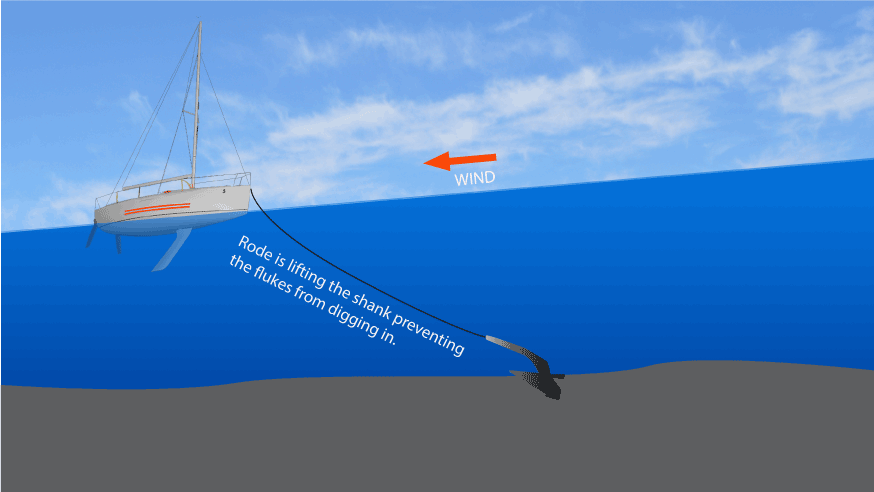
Scope Too Short
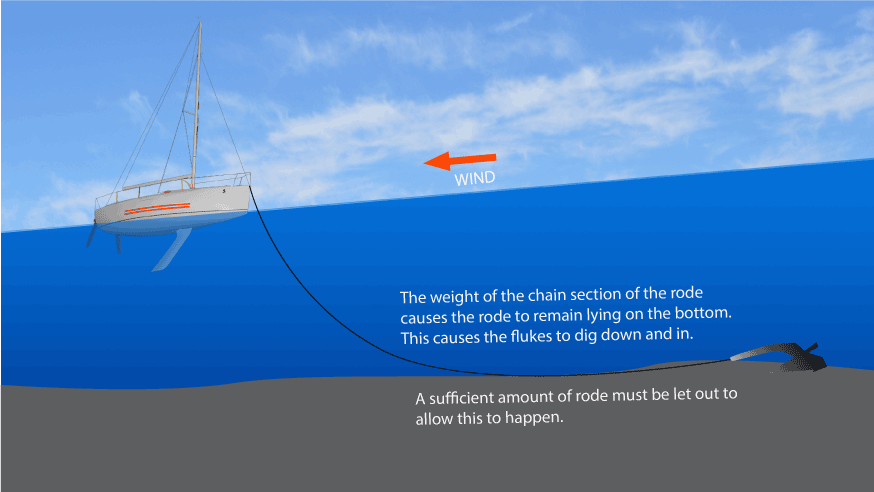
Sufficient Scope
Balancing the decision
Letting out more rode gives better holding power, but it has to be balanced against the diameter of your swing if the wind shifts. This is why prudent sailors settle on tried-and-true formulas — and why prudence also means keeping a watchful eye to make sure the anchor is not slipping.
Factors to weigh:
- How crowded the harbor is
- That some boats will be on all chain (less swing) and others on rope and chain (more swing)
- Your own swing circle
- Predicted overnight wind shifts and strengths
- Tidal change
- How much chain you have before the rope begins
- How close you are to shore or to underwater rocks
Because of all these, set a GPS anchor alarm and a depth change alarm to warn you if you have moved — and set several ordinary alarms as well, so you get up through the night and check.
NauticEd has a free anchor alarm App called Anchor Zone on iOS and it is free for NauticEd students who have the skipper course in their curriculum – else it’s $5.
Knowing how much you have paid out
Finally, you need a way to tell how much rode has gone over the bow. Mark the chain and the nylon line every 25 ft (7 m). Chandleries carry markers for this; paint in different colors works well on chain, and many people use nylon tie wraps — one at 25 ft, two at 50 ft, three at 75 ft.
Here’s a fun video where we dive the anchor to check its set, along with a few other things we found on the bottom.
Notes
- If you plan to stay awake and aware while anchored for a short time and the wind is light, you may be able to lessen your scope.
- Anchoring in deeper water — over 30 ft (9 m) — creates a large swing circle, which is often undesirable.
- In general, try to anchor shallower, keeping tide, swing, and obstacles in mind.
- In general, the more rode you let out, the better the anchor holds.
Anchor and Rode Inspection
Since your boat and your life depend on your anchor’s ability to hold you off the rocks, it is worth making sure the rode will not let you down.
At least every six months:
- Inspect the full length of the rode for rust and abrasion
- Inspect the connections from rope to chain and chain to anchor
- Ensure the pin in the D-ring connecting chain to anchor is secured with stainless steel wire so it cannot work free
- Inspect the cleat that holds the rode to the boat to ensure it is solidly mounted
- Ensure the bitter end is firmly attached to the vessel, usually to a dedicated cleat in or near the anchor locker
- Inspect the mounting of the windlass, if fitted
You can learn more in the Skipper Course....
Knowledge and theory for longer distances and overnight sailing in diverse conditions. The Skipper Course is a comprehensive online sailing course for beginner to intermediate sailors wanting to learn how to sail larger sailboats 26ft to 56ft. Or upgrade to the Skipper Course Bundle of online courses to also master maneuvering under power and docking!