Life Rafts 101
When, Why, and How Competent Boaters Use Them
This guide breaks down the purpose, construction, deployment, and limitations of modern life rafts, helping boaters understand the difference between coastal and offshore rafts, what features truly matter, and how proper preparation and competence influence outcomes. Whether you sail coastal waters or offshore passages, understanding life rafts is a critical part of making informed safety decisions before an emergency ever occurs.
A life raft is one of the most serious pieces of safety equipment on a boat – and also one of the most misunderstood.
Competent boaters don’t treat life rafts as an accessory or a “just in case” item. They understand when a life raft is appropriate,how it works, and what features actually matter when conditions have already gone very wrong.
This guide breaks down the essentials of life rafts in plain language – what they are, how they’re used, and how to think about choosing the right one for your type of boating.
▶️ Watch: Life Rafts Explained – Structure, Deployment, and Features
This video walks through a real life raft, explains how they deploy, and clarifies the differences between coastal and offshore life rafts – with a strong emphasis on seamanship and decision-making.
Partner Shout-Out: This video was made possible with help from our friends at LRSE. If you’re looking for a life raft, check them out at https://www.lrse.com. Good gear supports good seamanship.
The Fundamental Rule of Using a Life Raft
There’s a long-standing rule at sea: Never step down into a life raft.
Meaning, don’t abandon a vessel that is still providing flotation, visibility, and survival advantages. A life raft is a last resort, used only when the boat is either sinking rapidly or on fire. Many people have been found safely inside life rafts – while their boat was still floating nearby.
Your vessel, even when damaged, is:
- Easier to see
- Easier to find on radar
- More stable than a raft
Competence means knowing when not to deploy just as much as knowing how. Competent boaters:
- Stay with the vessel whenever possible
- Understand how their life raft deploys
- Choose features based on exposure and rescue timelines
This mindset saves lives.
Life Raft Anatomy: Core Components Explained
While brands and models vary, most modern life rafts share a similar core design:
Coastal vs Offshore Life Rafts: What’s the Difference?
Life rafts aren’t one-size-fits-all – the right raft depends on where you boat and how long you may need to wait for help.
What Is a Coastal Life Raft?
- Typically single-tube platforms
- May or may not have a canopy
Coastal Life Rafts Are Designed For
- Smaller vessels
- Near-shore or coastal waters
- Shorter rescue timelines
What Is an Offshore Life Raft?
- Two-tube construction for redundancy
- Fully enclosed canopy
- Assume rescue may take time – and are built accordingly.
Offshore Life Rafts Are Designed For
- Offshore passages
- Extended exposure
- Harsher environments
How Life Rafts Deploy: Valise vs Canister Types
Most life rafts inflate using a CO₂ cylinder, triggered by the painter line, while canister life rafts can be deployed manually. Some are even equipped to release automatically if the boat sinks.
Valise (Soft-Bag) Life Rafts
- Stored below deck or in a locker
- Must be dry & accessible
Canister Life Rafts
- Stored on deck in a cradle
- May include a hydrostatic release
Critical seamanship reminder
Regardless of type, accessibility matters. A life raft buried under gear is not a usable life raft.
Life Raft Stability: Capsize Risks and Righting Techniques
Life rafts are designed to be stable – but capsize is still possible, especially in heavy seas.
To address this:
- Ballast pockets fill with water underneath the raft
- Righting straps or handles allow occupants to flip the raft upright if needed
This is another reason offshore life rafts emphasize canopies, stronger structure, and independent buoyancy chambers.
What’s Inside a Life Raft: Equipment Packs and Essentials
There are many equipment pack configurations – and deciding what matters most depends on where and how you boat.
Most life rafts include a basic equipment pack:
- Bailers and sponges
- Leak stoppers
- Paddles
More advanced packs in life rafts may also include:
- Drinking water
- Emergency food
- Flares and signaling devices
Life Raft Maintenance, Service Life & Reliability
A well-built life raft can last 12–20 years, depending on:
- Manufacturer
- Materials
- Storage conditions
Most recreational life rafts require servicing every three years, though this varies by brand. Regular service ensures:
- Inflation systems work
- Seals remain intact
- Equipment packs are current
Important Note: A life raft is only reliable if it’s properly maintained.
How to Choose the Right Life Raft for Your Boat
Different manufacturers emphasize different priorities. For example, Winslow is known for lightweight, high-end options, while brands like Viking, Revere, and Superior are often chosen for durability and long service life.
The “best” life raft is the one that:
- Matches your boating environment
- Is properly sized for your crew
- And, most importantly, is accessible and serviced as required
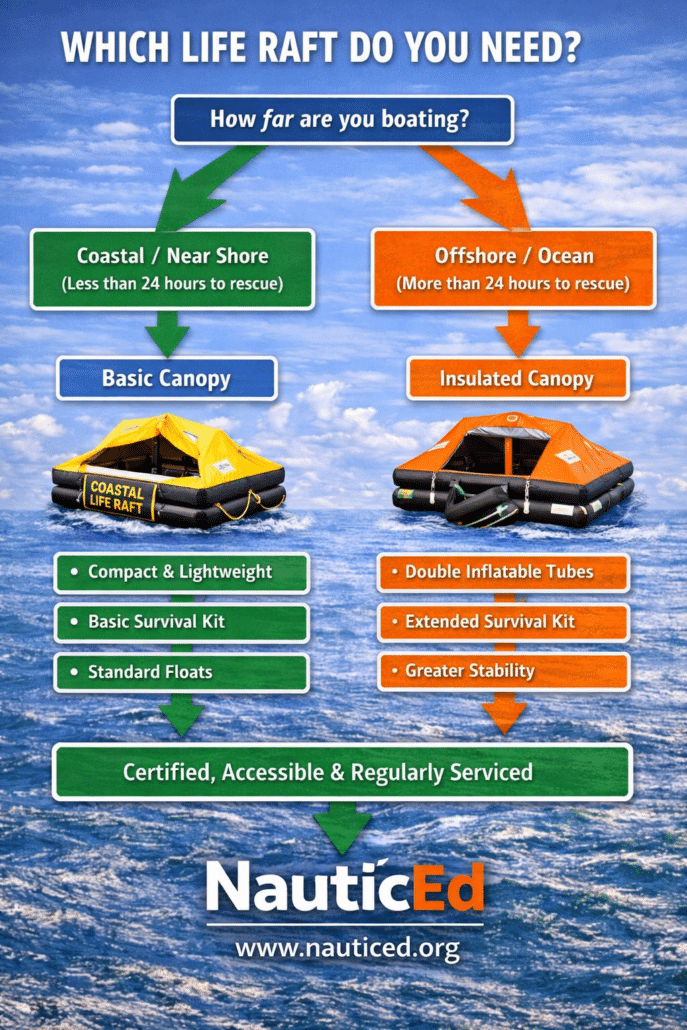
Quick Guide: Coastal vs Offshore Life Raft Decision Chart
A Quick Decision Guide for Coastal and Offshore Boaters
Frequently Asked Questions About Life Rafts
When should a life raft actually be deployed?
A life raft should only be deployed when remaining with the vessel is no longer safer than abandoning it. This typically occurs when a boat is sinking, burning, capsized beyond recovery, or otherwise no longer habitable. A life raft is a last-resort survival tool – not a precautionary convenience.
What is the difference between a coastal and an offshore life raft?
Coastal life rafts are designed for short-duration survival in relatively protected waters and milder conditions. Offshore life rafts are built for extended survival, rough seas, and greater exposure, with features such as canopies, insulated floors, ballast pockets, and more comprehensive equipment packs.
How does a life raft deploy?
Most life rafts deploy by pulling a painter line, which inflates the raft automatically. Rafts may be stored in either a valise (soft bag) or a canister, depending on mounting location and intended use. Proper stowage and familiarity with deployment are critical to ensure the raft inflates correctly in an emergency.
What is inside a life raft equipment pack?
Life raft equipment packs typically include signaling devices, survival tools, water, first-aid supplies, and other essentials. Offshore rafts generally carry more comprehensive packs than coastal rafts. The exact contents vary by manufacturer and service category, making it important to review what’s included before purchasing.
How stable are life rafts in rough conditions?
Modern life rafts are designed with ballast pockets and weighted floors to reduce the risk of capsizing. If a raft does invert, most are engineered so occupants can right the raft using exterior grab lines. Stability depends on design, loading, and sea conditions.
How long does a life raft last, and how often does it need servicing?
Life rafts have a defined service life and must be professionally inspected and serviced at regular intervals to remain reliable. Environmental exposure, storage conditions, and maintenance history all affect longevity. An unserviced life raft cannot be assumed to function correctly in an emergency.
How do I choose the right life raft for my boat?
Choosing the right life raft depends on where you sail, how long help may take to arrive, and the conditions you may encounter. Features, capacity, service category, and equipment matter more than brand name. The right choice supports competence, preparation, and realistic risk assessment.
Is a life raft required for recreational boating?
Life raft requirements vary by location, vessel type, and voyage category. While not always legally required, life rafts are often recommended for offshore or extended passages as part of a broader safety and risk-management strategy.
NauticEd’s Perspective on Safe Raft Use
A life raft is not a substitute for seamanship. It’s a contingency for when seamanship is no longer enough.
At NauticEd, we teach that competence is built from knowledge, practical skills, and experience – and the right equipment supports all three. Continue developing your safety and weather knowledge through NauticEd’s competence-based education – where decisions are grounded in reality, not fear or checklists.
GET STARTED NOW!
Join NauticEd for FREE
✔ Free online course(s) to get you underway
✔ Free eLogbook (record your boating adventures)
✔ Free boating resume tool (fully integrated, build your boating resume)
✔ Special discounts and offers from partners (and no, we don’t share your email address)
✔ No obligation, No cost to sign up