Marine Flares 101
How They Work, When to Use Them, and What to Carry
This guide breaks down the main types of marine flares, how they’re used, and how competent boaters think about choosing the right mix for coastal and offshore boating.
When it comes to emergency signaling, flares are still one of the most effective ways to attract attention on the water. But not all flares serve the same purpose – and using the right type at the right time matters just as much as carrying them in the first place.
▶️ Watch: Marine Flares Guide
In this video, we explain the main types of marine flares, how they work, and when each type should be used.
Partner Shout-Out: This video was made possible with help from our friends at LRSE. LRSE offers a wide selection of marine flares and other emergency equipment, check them out at https://www.lrse.com. Good gear supports good seamanship.
The Main Types of Marine Flares
Marine flares generally fall into three categories: handheld flares, aerial (parachute or projectile) flares, and smoke flares. Each has a specific role depending on distance, visibility, and whether help can already see you.
Handheld Flares: Close-Range Visibility
Handheld flares are best used when another vessel already has a visual on you. They’re not intended for long-range signaling, but rather to help nearby rescuers pinpoint your exact location.
USCG-Approved vs SOLAS Handheld Flares
There are two common types of handheld flares:
U.S. Coast Guard–approved handheld flares
These use a flint-style ignition system. They burn at roughly 900 candela and produce hot, dripping slag as they burn. Because of this, they must be held at an angle to avoid injury or damage to your vessel or life raft.
SOLAS handheld flares
SOLAS flares burn significantly brighter – around 15,000 candela – do not drip slag, and are generally easier to operate. Their higher brightness makes them easier to see in challenging conditions.
Critical seamanship reminder
Because of the slag produced by USCG-approved handheld flares, careful handling is critical. Always angle the flare away from yourself, your crew, and any inflatable equipment.
Aerial and Gun-Type Flares
Some life rafts include aerial flares that do not launch as high, burn as bright, or last as long as parachute flares. Gun-type flares share similar limitations.
Against background light (such as near coastal cities) these flares may be difficult to distinguish. They can still be useful, but they should not be relied upon as your primary long-range signaling method.
Parachute Flares: Long-Range Signaling
When you need to signal vessels on the horizon or aircraft, parachute flares are the most effective option.
A parachute flare launches high into the air – often up to 1,000 feet – and burns brightly for approximately 15 seconds. This height and duration make parachute flares difficult to miss and clearly recognizable as a distress signal.
A common signaling technique is to fire one parachute flare followed shortly by another. The first flare may be interpreted as a possibility; the second confirms that assistance is truly needed.
SOLAS parachute flares are generally the most visible option available and are strongly recommended for offshore boating.
Smoke Flares: Daytime Visibility
Smoke flares are designed for daytime use only and are especially effective when aircraft are nearby.
SOLAS smoke flares
These produce thick, billowing orange smoke for up to three minutes and are visible from miles away.
USCG-approved smoke flares
These emit a thinner trail of smoke and burn for a shorter duration.
Smoke flares are best deployed once rescuers are already in the area and need help locating you precisely.
Safety Considerations When Using Flares
Flares are powerful tools and must be handled carefully:
- Always hold handheld flares at an angle
- Be mindful of hot slag from USCG-approved flares
- If a projectile flare misfires, do not look at it
- Place it safely away from crew and equipment and allow it to cool
Understanding flare operation before an emergency is essential. This is not equipment you want to figure out under stress.
How Many Flares Should You Carry?
All vessels are required to carry day–night signaling devices, but the exact mix is ultimately a judgment call based on how and where you boat.
A practical baseline recommendation:
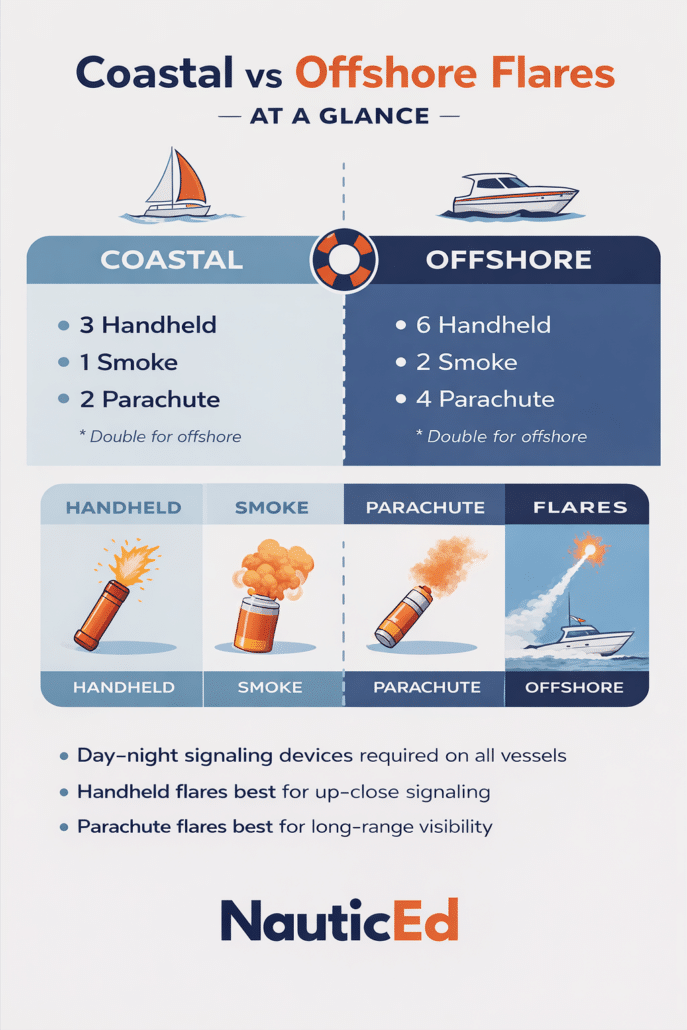
Coastal Boating
- Three handheld flares
- Two parachute flares
- One smoke flare
Offshore Boating
- Double the coastal kit
Certain activities, such as racing or commercial operations, may have additional requirements, but for recreational boaters, this approach provides layered capability for both close-range and long-range signaling.
Quick Guide: Coastal vs Offshore Flares
A Quick Guide for Coastal vs Offshore Flares For Boaters
Frequently Asked Questions
What are marine flares used for?
Marine flares are visual distress signals used to attract attention during an emergency on the water. They are designed to be seen by nearby vessels, aircraft, or people on shore when immediate assistance is needed.
What are the main types of marine flares?
The main types of marine flares include handheld flares, aerial flares, parachute flares, and smoke flares. Each type serves a different purpose depending on range, visibility conditions, and whether it is day or night.
What is the difference between handheld and aerial flares?
Handheld flares are best for close-range signaling, especially when rescue vessels are nearby. Aerial flares are launched into the air and are intended for long-range visibility, making them useful when help may be farther away.
What is the difference between U.S. Coast Guard-approved and SOLAS flares?
U.S. Coast Guard-approved flares meet recreational boating requirements, while SOLAS flares are built to a higher international standard with greater brightness, longer burn times, and increased visibility, typically intended for offshore or commercial use.
When should marine flares be used?
Marine flares should only be used in a real emergency when there is an immediate risk to life or vessel safety. Because flares burn hot and are time-limited, they should be deployed strategically when there is a reasonable chance of being seen.
How many marine flares should I carry on my boat?
The number of flares you should carry depends on where and how you boat. Coastal boaters typically carry the minimum required by regulations, while offshore boaters often carry additional flares and multiple types to account for longer rescue times.
Are expired marine flares still usable?
Expired flares may still ignite, but they cannot be relied upon for emergency use and no longer meet regulatory requirements. Expired flares should be properly disposed of and replaced to ensure reliable performance when needed.
Are electronic flares allowed instead of traditional flares?
In some regions, electronic distress lights may be accepted as an alternative to certain traditional flares, but they often do not fully replace all required visual signals. Boaters should verify current regulations before relying solely on electronic options.
What safety precautions should be taken when using flares?
Marine flares burn extremely hot and produce molten slag. They should be held downwind, away from the body and vessel, and used carefully to reduce the risk of burns or onboard fires.
What’s the difference between coastal and offshore flare requirements?
Coastal flare setups are designed for shorter response times and closer visibility, while offshore flare kits emphasize long-range detection, redundancy, and extended signaling capability in case rescue takes longer.
NauticEd’s Perspective
Competence Is More Than Compliance.
Carrying flares is only part of the equation. Knowing which flare to use, when to use it, and how to use it safely is what turns equipment into real preparedness. Flares remain one of the clearest ways to say “we need help” on the water – but only when they’re chosen and used with understanding.
At NauticEd, we teach that competence is built from knowledge, practical skills, and experience – and the right equipment supports all three. Continue developing your safety and weather knowledge through NauticEd’s competence-based education – where decisions are grounded in reality, not fear or checklists.
GET STARTED NOW!
Prepare for the unexpected and boat with confidence with our Safety at Sea online course...
Designed by Captain Ed Mapes, NauticEd’s comprehensive Safety at Sea Online Course equips boaters with vital skills and knowledge to handle emergency situations effectively – MOB, jury-rigs, ditch bags, fire/flooding, heli-evac, and more.