
Experience ≠ Competency
by Bill Ibsen
I should have seen it coming. I’ve encountered this same kind of student before, when I was a high-performance driving instructor at the Porsche Experience Center. They are typically mature, confident, wealthy males – many of whom are leaders in their companies and are accustomed to being applauded or admired by others. They believe they are fast, impressive drivers and can’t wait to show off for the instructor. Many quietly brag about the expensive Porsche 911s they’ve owned, giving the impression that they are uniquely serious Porsche enthusiasts.
Transparently, these were the students I least enjoyed instructing. They were difficult to teach because they thought they had little left to learn. Even worse was sitting in the passenger seat of a new $150,000 Porsche with an overconfident but unskilled driver ripping around a racetrack – it was genuinely terrifying at times. They could get themselves – and their instructor – into serious trouble in milliseconds, making cascading errors that risked injury or even death for both of us. That’s exactly why I no longer instruct unfamiliar drivers on the racetrack.
I’m newer to sailing instruction, so I didn’t immediately recognize the sailing version of this overconfident student. A few days ago, one told me he had been sailing his entire life (he was around 60). He had started as a child racing dinghies and later owned no fewer than three medium-sized sailboats as an adult. He had also chartered Moorings sailing vessels in the BVI at least ten times and had just returned from chartering a PowerCat there.
He wanted his SLC (Sailing License Credential) because it is required for chartering in the Bahamas, where he planned to sail in a month. He said he had already passed the NauticEd SLC examination and just needed the practical assessment to complete his license. “Well then, this assessment should be a breeze,” I thought.
I performed his assessment and failed this highly experienced student. At the same time, on the same boat in the same light-air conditions, I passed a younger, less “experienced” student.
How is this possible? How could a lifelong, seasoned sailor fail both the NauticEd SLC dockside written exam and the practical assessment? How could someone who looked so qualified on paper fail a verified test of practical competency?
Here are my six key learnings from instructing this type of student:
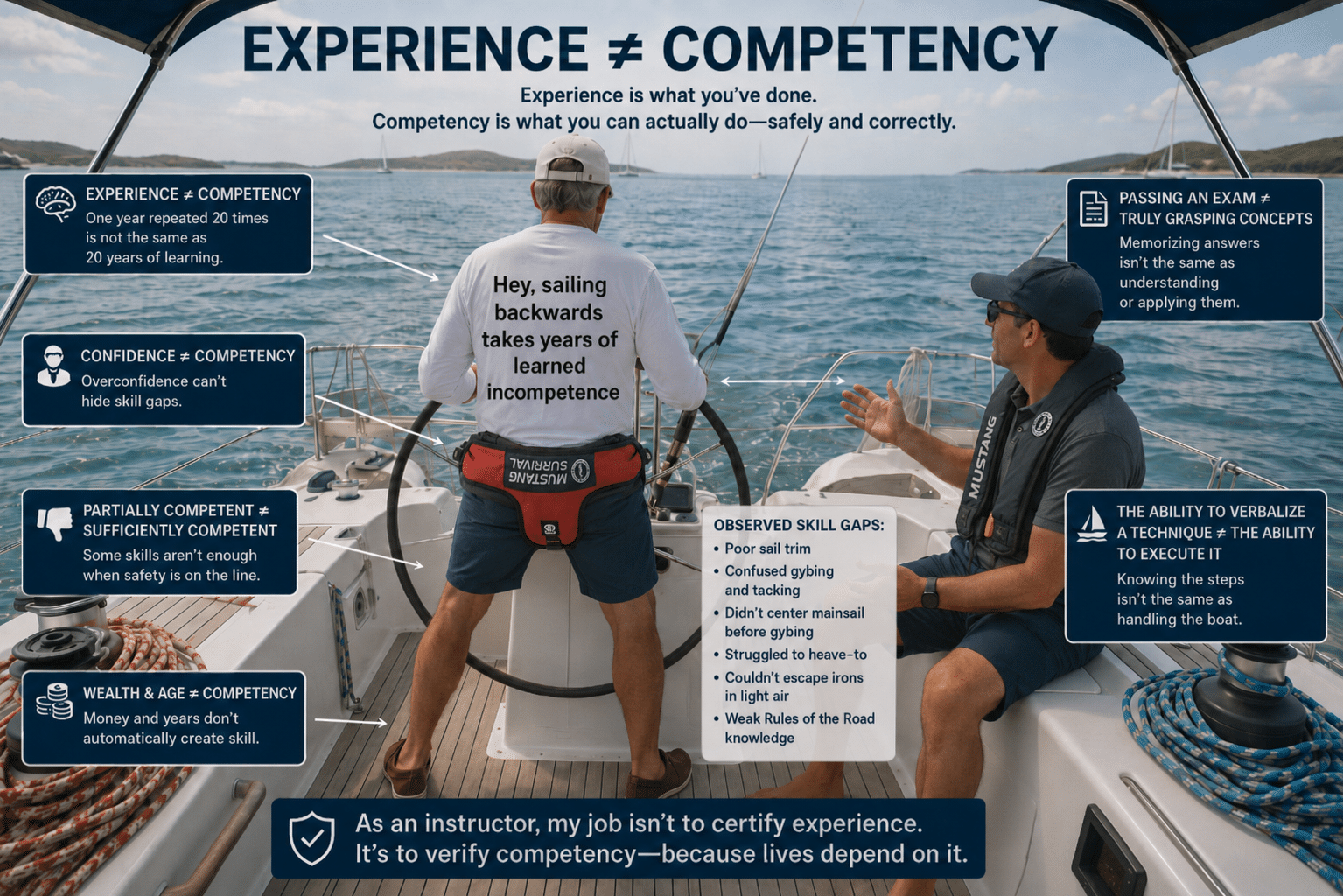
Experience ≠ Competency
There is no necessary correlation between experience and competency—only a partial one. Skilled HR managers know that when a candidate claims “20 years of experience,” it’s essential to probe deeper. That person may have one year of experience repeated 20 times, or 20 years of continuous learning and improvement. There’s a massive difference between the two.
I concluded that my student had simply repeated the same poor habits for decades. He was unaware that he had been “doing it wrong” all these years. I told him he needed sailing instruction, not a license assessment. It was painfully obvious to both me and the other student that he struggled with basic sail trim for different points of sail.
For example, he would have his sails set close-hauled with the wind coming from 170° and then sort of freeze because the boat wasn’t moving forward well. He confused the words “gybing” and “tacking,” and in preparation for the gybe, wouldn’t first center the mainsail, but instead would fiddle around with the traveler position.
Confidence ≠ Competency
Some people have an inflated view of their own skills and a remarkable ability to excuse or minimize their errors. They present themselves as firmly confident (and often strongly opinionated), but their subjective internal standards frequently fall short of objective external ones, such as those set by the American National Standard. When the subjective meets the objective, the skill gaps become glaringly obvious.
Partially Competent ≠ Sufficiently Competent.
While my student could demonstrate some skills, he could not demonstrate enough for me – as his assessor – to confidently recommend him to a charter company. I could not say, “This charterer has shown me he knows what he’s doing and is a safe risk for your $1–2 million yacht, himself, and his crew.”
He was a confident powerboater but couldn’t figure out how to heave-to or escape irons in light air. That struck me as surprising for someone who had supposedly sailed since childhood – skills that should have been burned into his DNA by now.
Wealth and Age ≠ Competency
Money can’t buy skill (or love). I’ve seen racetrack drivers with the financial horsepower to buy a $300,000 Porsche GT3RS and fling it around as if they’re skilled racers, when they’re really just full of testosterone and inflated self-esteem. Likewise, the ability to afford expensive sailboats – or many of them – does not automatically translate into the ability to sail one safely and competently.
Age is also unrelated to skill; some kids are better sailors than many adults. Sixteen-year-old Jessica Watson, who solo-circumnavigated the world, comes to mind.
Passing an Exam ≠ Truly Grasping the Concepts
Some students are more motivated to pass a test and obtain certification than to genuinely improve their skills. For them, the test is simply a means to an end. They learn just enough correct answers to pass without understanding the underlying principles.
My student wanted the SLC primarily to bareboat charter in the Bahamas. Despite claiming 7,500 miles of sea experience – including coastal deliveries – he missed several Rules of the Road questions, many ATON questions, and nearly all questions on lights, compass, chart symbols, and radio channels (or left them blank). Meanwhile, his younger fellow student passed the same test with few errors. All the failing student could do at that point was criticize the SLC written test as being in a different, more difficult format than the multiple-choice version he had taken online. Parenthetically, emotionally intelligent skippers always “own his/her own dirt,” and don’t blame-shift.
The Ability to Verbalize a Technique ≠ The Ability to Physically Execute It
Knowing the sequence of a technique does not mean you can get your body and the boat to perform it. There is a real gap between cognition and execution, which is why theorists aren’t necessarily practitioners. When a confident student claims they already know how to perform a task but I suspect they can’t, I ask: “Since you say you know how to do it, it should be easy to show me – so please do so now.” Yesterday, my student confidently insisted he knew the theory and “could pass NauticEd’s SLC online exam tonight!” (See “Confidence ≠ Competency” learning above.)
As an instructor, the saddest part of his approach is this: If a student cannot pass a theory test they ostensibly studied for in the comfort and safety of land, how will they handle the real-life pressure of a sudden storm, a constant-bearing decreasing-range collision situation, hitting a reef, or a burst of Bora winds in Croatia – while entrusted with the safety of a chartered yacht and the lives of family and friends? These theory tests are not merely about quick memorization and regurgitation. An enormous portion of the content is directly tied to safety. The intelligent and prudent person learns from the mistakes of others rather than through painful, avoidable, and costly mistakes of their own. That’s one of the primary benefits of sailing instruction.
The greatest satisfaction I derive as an instructor is seeing a student’s confidence and skill level demonstrably increase. However, overconfident, under-skilled, and under-prepared students present a unique challenge. Delivering gentle yet direct, constructive feedback – that they are not as skilled as they believe – can be difficult. I always hope I’ve built enough relational equity for the student to listen openly rather than become defensive. Unfortunately, defensiveness is the default response for some.
I may receive a low review from this student, but I have a clear conscience knowing that I
(1) upheld the ANSI standards I’m entrusted to verify, and
(2) did not certify an incompetent sailor whom I would not want skippering my own $1.2 million boat rented out in the Moorings charter fleet.
From this experience, I will (hopefully) never again confuse experience with competency. While related, they simply aren’t the same thing.
###