Why Your Gear Should Match Forecast Conditions
How to Choose the Right Foul Weather Boating Gear for Your Conditions
Inshore gear is for short, protected outings. Coastal gear adds coverage and visibility for longer exposure. Offshore gear is survival equipment for breaking seas and long watches.
Choosing foul weather gear isn’t about marketing claims or brand loyalty – it’s about matching your gear to weather conditions.
Competent boaters understand that foul weather gear is not just clothing, it’s critical safety equipment. And the wrong jacket offshore isn’t just uncomfortable in inclement weather conditions, it’s also dangerous. In this guide, and in the video below, we will break down the real, functional differences between inshore, coastal, and offshore foul weather jackets, so you can make informed, experience-based decisions when choosing your sailing or boating gear.
▶️ Watch: Offshore vs Coastal vs Inshore Foul Weather Gear Explained
This video walks through real foul weather jackets and explains exactly why features change as weather conditions become more demanding.
Foul Weather Gear Categories Explained
When conditions on the water get cold and wet, performance degrades first and judgment follows.
Loss of core body heat can lead to fatigue, slower reaction times, poor decision-making, and eventually hypothermia. This is why experienced boaters treat foul weather gear the same way they treat life jackets, tethers, and jacklines: it is part of their core safety system.
Staying dry protects your core temperature, helping to keep your mind sharp, and allowing you to remain effective on watch.
Inshore Foul Weather Gear – Best for Protected Waters
DAY SAILING OR SAILING IN PROTECTED WATERS
Inshore foul weather jackets are designed for staying close to shore in relatively benign conditions. These jackets do exactly what they’re intended to do – keep you dry during short, near-shore outings. However, they are not designed for prolonged exposure, heavy seas, or repeated wave impact.
Key features include:
🗸 Fully waterproof fabric with taped seams
🗸 A basic roll-away hood
🗸 Minimal pockets and adjustments
🗸 Lightweight construction focused on rain protection
Coastal Foul Weather Gear – Added Coverage & Comfort
Coastal cruising, overnight passages, and mixed conditions
When moving into coastal passages, conditions become less predictable. Wind increases, nights get colder, and exposure time extends.
Coastal foul weather jackets typically add:
🗸 A longer cut for better overlap and coverage
🗸 Additional pockets, including hand warmer pockets
🗸 A higher collar that reaches mouth level
🗸 A fluorescent hood for visibility in man-overboard scenarios
Critical seamanship reminder
If your jacket has a hood – keep it out. Fluorescent hoods exist for a reason: visibility when it matters most.
Offshore Foul Weather Gear – Built for Harsh Conditions
Offshore passages, ocean racing, cold water boating or sailing, and extended exposure.
Offshore foul weather gear is not a “nicer jacket”, it’s specifically engineered survival equipment. This gear exists because offshore boating assumes things will get hard – and help you to prepare for it.
High Collar & Fully Adjustable Hood:
🗸 Collars rise to nose level
🗸 Multi-point hood adjustments prevent obstruction of vision
🗸 Integrated face shields protect against breaking waves
🗸 Designed to be used with goggles in extreme conditions
Longer Length for Double Protection:
🗸 Extended jacket length overlaps bibs
🗸 Allows layering flexibility in warm or cold offshore environments
🗸 Reduces water ingress when seated or on watch
Visibility, Warmth, and Recovery:
🗸 Reflective panels for night detection
🗸 Fleece-lined chest and cargo pockets
🗸 Pockets allow drainage and re-insulation after taking in water
Double Cuffs That Prevent Water Intrusion:
🗸 Inner elastic cuffs create a true wrist seal
🗸 Prevent water from being forced up sleeves during deck work
🗸 Critical for maintaining dryness over long watches
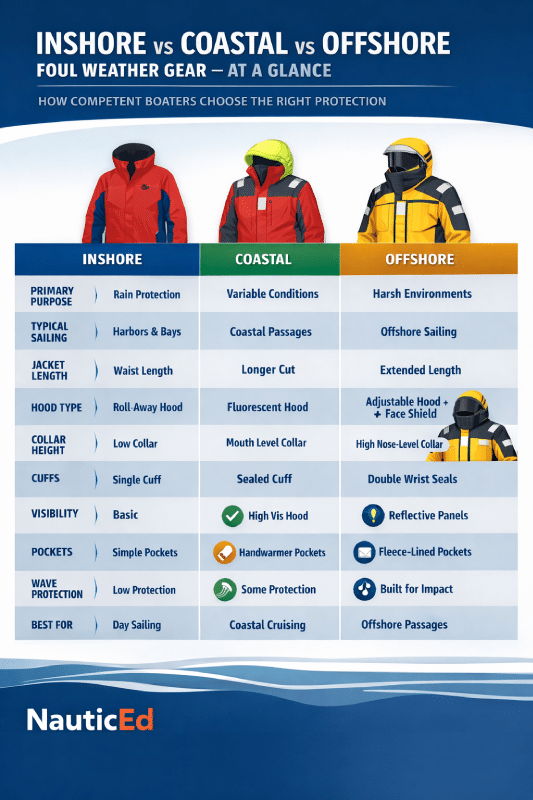
Quick Comparison: Inshore vs Coastal vs Offshore Gear
Competent sailors don’t ask “What jacket looks best?” They ask “What conditions am I preparing for?”
FAQ – Choosing Foul Weather Boating Gear
Choosing appropriate foul weather gear is part of seamanship. It reflects an understanding of conditions, exposure, and risk – not just comfort and style preferences.
What is the difference between inshore, coastal, and offshore foul weather gear?
Answer:
Inshore foul weather gear is designed for short, near-shore outings in mild conditions. Coastal gear adds coverage and features for variable weather and longer exposure. Offshore gear is engineered for harsh open water conditions with extended protection, longer cut, integrated face shields, and advanced waterproofing.
Why is foul weather gear considered safety equipment, not just clothing?
Answer:
Because staying dry protects your core body temperature, which preserves mental sharpness and decision-making ability in bad weather. Gear that fails to keep you dry can lead to fatigue, slower reactions, and even dangerous outcomes.
What features should I look for in foul weather gear?
Answer:
Key features include fully waterproof fabric with taped seams, longer cut for extra coverage, a high collar, multiple adjustment points, integrated face shields for offshore gear, reflective panels for visibility, and inner cuffs that prevent water entry.
Can I use the same foul weather gear for both coastal and offshore conditions?
Answer:
While coastal gear works well for variable conditions near shore, it’s not suitable for prolonged offshore exposure. Offshore conditions require more robust protection, higher collars, greater layering ability, and features that keep you dry for extended time at sea.
How should I match my foul weather gear to the conditions I expect to encounter?
Answer:
Determine where you’ll be boating most often and for how long. If you’re mostly near shore in shorter outings, inshore gear is sufficient. For extended cruises with variable conditions, choose coastal gear. For offshore or long blue-water passages, invest in offshore-rated gear with advanced protection features.
Is visibility in foul weather gear important?
Answer:
Yes. Coastal and offshore gear often includes fluorescent hoods or reflective elements to increase visibility in man-over-board scenarios or low-light conditions. Visibility features can be crucial for safety in bad weather.
At NauticEd, we teach that competence is built from knowledge, practical skills, and experience – and the right equipment supports all three. Continue building your seamanship with NauticEd’s competence-based boating education – where decisions are grounded in real-world conditions, not checklists or shortcuts.
GET STARTED NOW!
Join NauticEd for FREE
✔ Free online course(s) to get you underway
✔ Free eLogbook (record your boating adventures)
✔ Free boating resume tool (fully integrated, build your boating resume)
✔ Special discounts and offers from partners (and no, we don’t share your email address)
✔ No obligation, No cost to sign up