Sound Signals for Vessels
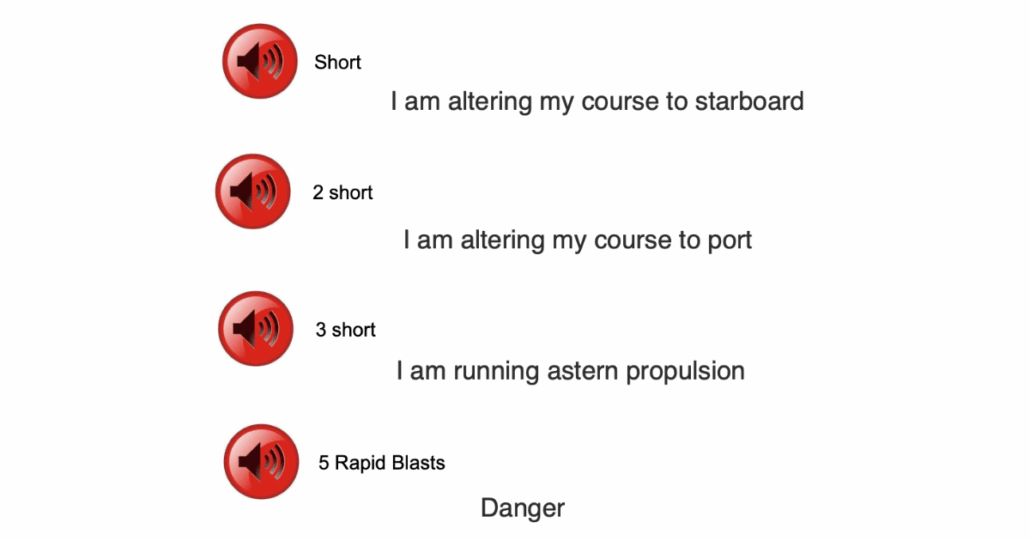
The basic sound signals you should know are shown below. This information is embedded in the NauticEd Skipper Course and the NauticEd RYA Day Skipper Course.
Also, download our Navigation Rules eBook for iPad where the complete set of Navigation Rules are given and explained with animations – ONLY $2.99.
Tap each image to hear an example sound.
A short blast is to be one second long
A prolonged blast is to be between 4 and 6 seconds.
Between each successive signal you should wait 10 seconds or more.
These sounds are to made by power-driven vessels greater than 12 meters (39ft) in length and when operating in a narrow channel and have sighted each other.
I am altering my course to starboard
I am altering my course to port
I am running astern propulsion
Danger
The danger signal is general and can be used by anyone to signal disagreement with another vessel’s signal, which may lead to danger or just danger in general to anyone.
Sailboat in Fog
When operating in areas of restricted visibility IE fog, a Sailboat must make the following signal.
I am a sailboat in fog
Remember this by an average sailboat normally has two sails- thus the two shorts toots.
Powerboat if Fog
Where prolonged is a prolonged blast (lasting 4 to 6 seconds) and signals are not more than 2 minutes apart. This signal above (one prolonged and two short) is also the signal for other vessels operating in fog such as vessels towing, broken down, commercial fishing, or restricted in ability to maneuver.
Power driven vessels operating in fog must make the following signal not more than 2 minutes apart.
I am a power driven vessel in fog making way
I am a power driven vessel in fog stopped and making no way
These are international rules. The above list of signals is not exhaustive. For a list of all sound signals visit Rules 32 through 37 of the USCG regs (which again are international).
Finally, a piece of advice: Make sure you have a loud sound making device at hand at all times near the helm available with in 1-2 seconds. The day you will need it is the day you will thank yourself for heeding this advice.
Oh and BTW, that day WILL come – read this story about how it was too late